


Page 211 - Read Online
P. 211
Loh et al. Extracell Vesicles Circ Nucleic Acids 2023;4:568-87  https://dx.doi.org/10.20517/evcna.2023.34                                            Page 572


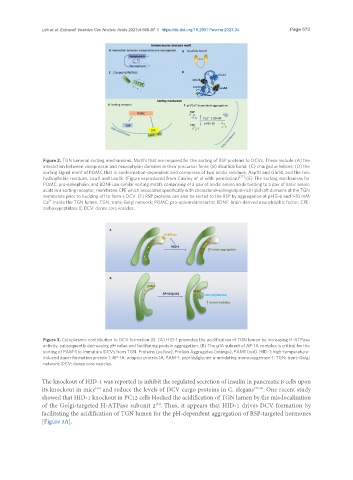
                Figure 2. TGN lumenal sorting mechanisms. Motifs that are required for the sorting of RSP proteins to DCVs. These include (A) the
                interaction between vasopressin and neurophysin domains in their precursor form; (B) disulfide bond; (C) charged α-helices; (D) the
                sorting signal motif of POMC that is conformation-dependent and comprises of two acidic residues, Asp10 and Glu14, and the two
                hydrophobic residues, Leu11 and Leu18. (Figure reproduced from Cawley et  al. with  permission) [27] ; (E) The sorting mechanism for
                POMC, pro-enkephalin, and BDNF use similar sorting motifs comprising of a pair of acidic amino acids binding to a pair of basic amino
                acids in a sorting receptor, membrane CPE which associates specifically with cholesterol-sphingolipid-rich lipid raft domains at the TGN
                membrane prior to budding off to form a DCV. (F) RSP proteins can also be sorted to the RSP by aggregation at pH 5-6 and 1-10 mM
                 2+
                Ca  inside the TGN lumen. TGN: trans-Golgi network; POMC: pro-opiomelanocortin; BDNF: brain-derived neurotrophic factor; CPE:
                carboxypeptidase E; DCV: dense core vesicles.


                Figure 3. Cytoplasmic contribution to DCV formation (I). (A) HID-1 promotes the acidification of TGN lumen by increasing H-ATPase
                activity, subsequently decreasing pH value and facilitating protein aggregation; (B) The µ1A subunit of AP-1A complex is critical for the
                sorting of PAM-1 to immature DCVs from TGN. Proteins (yellow), Protein Aggregates (orange), PAM1 (red). HID-1: high-temperature-
                induced dauer formation protein 1; AP-1A: adaptor protein 1A; PAM-1: peptidylglycine α-amidating monooxygenase-1; TGN: trans-Golgi
                network; DCV: dense core vesicles.


               The knockout of HID-1 was reported to inhibit the regulated secretion of insulin in pancreatic β cells upon
                                 [46]
               its knockout in mice  and reduce the levels of DCV cargo proteins in C. elegans [47,48] . One recent study
               showed that HID-1 knockout in PC12 cells blocked the acidification of TGN lumen by the mis-localization
                                                     [49]
               of the Golgi-targeted H-ATPase subunit 2 . Thus, it appears that HID-1 drives DCV formation by
               facilitating the acidification of TGN lumen for the pH-dependent aggregation of RSP-targeted hormones
               [Figure 3A].

