


Page 213 - Read Online
P. 213
Loh et al. Extracell Vesicles Circ Nucleic Acids 2023;4:568-87  https://dx.doi.org/10.20517/evcna.2023.34                                            Page 574


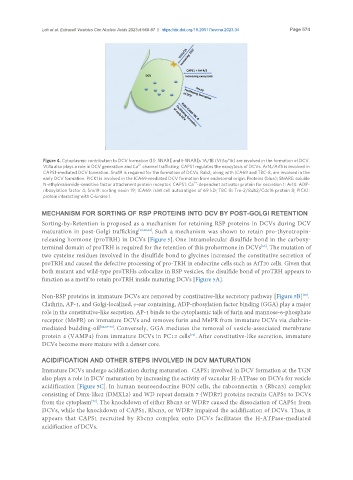
                Figure 4. Cytoplasmic contribution to DCV formation (II). SNARE and t-SNAREs 1A/1B (Vti1a/1b) are involved in the formation of DCV.
                                                2+
                Vti1a also plays a role in DCV generation and Ca  channel trafficking. CAPS1 regulates the exocytosis of DCVs. Arf4/Arf5 is involved in
                CAPS1-mediated DCV formation. Snx19 is required for the formation of DCVs. Rab2, along with ICA69 and TBC-8, are involved in the
                early DCV formation. PICK1 is involved in the ICA69-mediated DCV formation from endosomal origin. Proteins (blue); SNARE: soluble
                                                                  2+
                N-ethylmaleimide-sensitive factor attachment protein receptor; CAPS1: Ca -dependent activator protein for secretion 1; Arf4: ADP-
                ribosylation factor 4; Snx19: sorting nexin 19; ICA69: islet cell autoantigen of 69 kD; TBC-8: Tre-2/Bub2/Cdc16 protein 8; PICK1:
                protein interacting with C-kinase 1.

               MECHANISM FOR SORTING OF RSP PROTEINS INTO DCV BY POST-GOLGI RETENTION
               Sorting-by-Retention is proposed as a mechanism for retaining RSP proteins in DCVs during DCV
               maturation in post-Golgi trafficking [19,20,64] . Such a mechanism was shown to retain pro-thyrotropin-
               releasing hormone (proTRH) in DCVs [Figure 5]. One intramolecular disulfide bond in the carboxy-
               terminal domain of proTRH is required for the retention of this prohormone in DCVs . The mutation of
                                                                                         [65]
               two cysteine residues involved in the disulfide bond to glycines increased the constitutive secretion of
               proTRH and caused the defective processing of pro-TRH in endocrine cells such as AtT20 cells. Given that
               both mutant and wild-type proTRHs colocalize in RSP vesicles, the disulfide bond of proTRH appears to
               function as a motif to retain proTRH inside maturing DCVs [Figure 5A].


               Non-RSP proteins in immature DCVs are removed by constitutive-like secretory pathway [Figure 5B] .
                                                                                                       [66]
               Clathrin, AP-1, and Golgi-localized, γ-ear containing, ADP-ribosylation factor binding (GGA) play a major
               role in the constitutive-like secretion. AP-1 binds to the cytoplasmic tails of furin and mannose-6-phosphate
               receptor (M6PR) on immature DCVs and removes furin and M6PR from immature DCVs via clathrin-
               mediated budding-off [64,67-70] . Conversely, GGA mediates the removal of vesicle-associated membrane
               protein 4 (VAMP4) from immature DCVs in PC12 cells . After constitutive-like secretion, immature
                                                                 [71]
               DCVs become more mature with a denser core.

               ACIDIFICATION AND OTHER STEPS INVOLVED IN DCV MATURATION
               Immature DCVs undergo acidification during maturation.  CAPS1 involved in DCV formation at the TGN
               also plays a role in DCV maturation by increasing the activity of vacuolar H-ATPase on DCVs for vesicle
               acidification [Figure 5C]. In human neuroendocrine BON cells, the rabconnectin 3 (Rbcn3) complex
               consisting of Dmx-like2 (DMXL2) and WD repeat domain 7 (WDR7) proteins recruits CAPS1 to DCVs
               from the cytoplasm . The knockdown of either Rbcn3 or WDR7 caused the dissociation of CAPS1 from
                                [72]
               DCVs, while the knockdown of CAPS1, Rbcn3, or WDR7 impaired the acidification of DCVs. Thus, it
               appears that CAPS1 recruited by Rbcn3 complex onto DCVs facilitates the H-ATPase-mediated
               acidification of DCVs.

