


Page 214 - Read Online
P. 214
Page 575                                       Loh et al. Extracell Vesicles Circ Nucleic Acids 2023;4:568-87  https://dx.doi.org/10.20517/evcna.2023.34


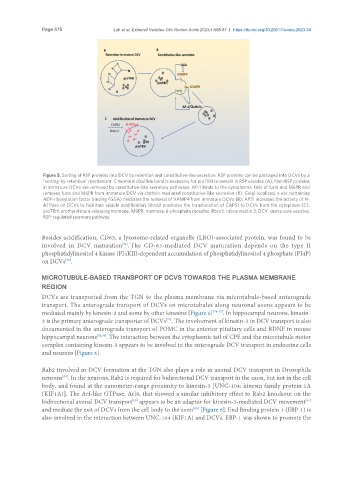
                Figure 5. Sorting of RSP proteins into DCV by retention and constitutive-like secretion. RSP proteins can be packaged into DCVs by a
                “sorting-by-retention” mechanism: C-terminal disulfide bond is necessary for proTRH to remain in RSP vesicles (A); Non-RSP proteins
                in immature DCVs are removed by constitutive-like secretory pathways. AP-1 binds to the cytoplasmic tails of furin and M6PR and
                removes furin and M6PR from immature DCV via clathrin-mediated constitutive-like secretion (B). Golgi-localized, γ-ear containing
                ADP-ribosylation factor binding (GGA) mediates the removal of VAMP4 from immature DCVs (B); APS1 increases the activity of H-
                ATPase on DCVs to facilitate vesicle acidification. Rbcn3 promotes the translocation of CAPS1 to DCVs from the cytoplasm (C).
                proTRH: prothyrotropin-releasing hormone; M6PR: mannose-6-phosphate receptor; Rbcn3: rabconnectin 3; DCV: dense core vesicles;
                RSP: regulated secretory pathway.


               Besides acidification, CD63, a lysosome-related organelle (LRO)-associated protein, was found to be
               involved  in  DCV  maturation . The  CD-63-mediated  DCV  maturation  depends  on  the  type  II
                                          [73]
               phosphatidylinositol 4 kinase (PI4KII)-dependent accumulation of phosphatidylinositol 4 phosphate (PI4P)
               on DCVs .
                       [73]

               MICROTUBULE-BASED TRANSPORT OF DCVS TOWARDS THE PLASMA MEMBRANE
               REGION
               DCVs are transported from the TGN to the plasma membrane via microtubule-based anterograde
               transport. The anterograde transport of DCVs on microtubules along neuronal axons appears to be
               mediated mainly by kinesin-3 and some by other kinesins [Figure 6] [74-77] . In hippocampal neurons, kinesin-
               3 is the primary anterograde transporter of DCVs . The involvement of kinesin-3 in DCV transport is also
                                                         [77]
               documented in the anterograde transport of POMC in the anterior pituitary cells and BDNF in mouse
               hippocampal neurons [78,79] . The interaction between the cytoplasmic tail of CPE and the microtubule motor
               complex containing kinesin-3 appears to be involved in the anterograde DCV transport in endocrine cells
               and neurons [Figure 6].


               Rab2 involved in DCV formation at the TGN also plays a role in axonal DCV transport in Drosophila
               neurons . In the neurons, Rab2 is required for bidirectional DCV transport in the axon, but not in the cell
                      [80]
               body, and found at the nanometer-range proximity to kinesin-3 [UNC-104: kinesin family protein 1A
               (KIF1A)]. The Arf-like GTPase, Arl8, that showed a similar inhibitory effect to Rab2 knockout on the
                                              [80]
                                                                                                        [81]
               bidirectional axonal DCV transport  appears to be an adaptor for kinesin-3-mediated DCV movement
                                                                  [80]
               and mediate the exit of DCVs from the cell body to the axon  [Figure 6]. End Binding protein 1 (EBP-1) is
               also involved in the interaction between UNC-104 (KIF1A) and DCVs. EBP-1 was shown to promote the

