


Page 25 - 2417
P. 25
Original Article  |  Open Access

                                          Carbon Footprints


                                        Chaib et al. Carbon Footprints 2026, 5, 23      DOI:10.20517/cf.2026.09


               A vulnerability-based approach for smallholder-led
               forest conservation


               João Chaib 1,2  , Christianne Corsini 1  , Michael Davies , Gwendolyn Smith , Camilla Pinheiro , Danilo
                                                              1
                                                                                              4
                                                                               3
               Centeno 5  , Niavo Ratsimbazafy , Raul Feldmann , Hongjun Wang 1
                                          1
                                                         1
               Keywords:
               Amazon, avoided
               deforestation, dynamic
               baseline, livelihood
               vulnerability, nature-based
               solutions, traditional
               communities, REDD+,
               regenerative agriculture
               Citation: Chaib, J.;
               Corsini, C.; Davies, M.;
               Smith, G.; Pinheiro, C.;
               Centeno, D.;
               Ratsimbazafy, N.;
               Feldmann, R.; Wang, H. A
               vulnerability-based
               approach for
               smallholder-led forest
               conservation. Carbon  Abstract
               Footprints 2026, 5, 23.
               https://dx.doi.org/10.20517  Smallholders account for a growing share of forest loss while holding a disproportionate
               /cf.2026.09         capacity to conserve and restore forests. Yet most Reducing Emissions from Deforestation
                                   and Forest Degradation (REDD+) methodologies remain scale- and actor-neutral, offering
               Received: 20 Jan 2026
               First Decision: 10 Mar  no systematic mechanism to equitably support these highly vulnerable rural communities.
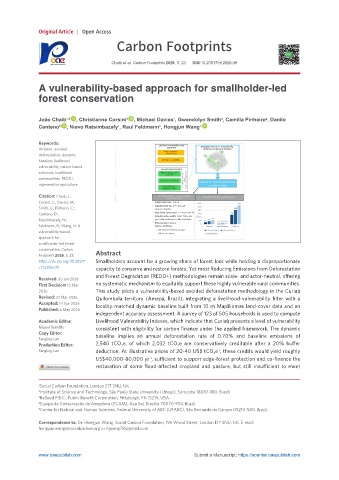
               2026                This study pilots a vulnerability-based avoided deforestation methodology in the Curiaú
               Revised: 23 Mar 2026  Quilombola   territory   (Amapá,   Brazil),   integrating   a   livelihood-vulnerability   filter   with   a
               Accepted: 14 Apr 2026  locality-matched dynamic baseline built from 10 m MapBiomas land-cover data and an
               Published: 6 May 2026
                                   independent accuracy assessment. A survey of 123 of 505 households is used to compute
               Academic Editor:    Livelihood Vulnerability Indexes, which indicate that Curiaú presents a level of vulnerability
               Miguel Brandão      consistent with eligibility for carbon finance under the applied framework. The dynamic
               Copy Editor:        baseline   implies   an   annual   deforestation   rate   of   0.70%   and   baseline   emissions   of
               Fangling Lan
               Production Editor:  2,540   tCO 2 e,   of   which   2,032   tCO 2 e   are   conservatively   creditable   after   a   20%   buffer
                                                                              -1
               Fangling Lan        deduction. At illustrative prices of 20-40 US$ tCO 2 e , these credits would yield roughly
                                   US$40,000-80,000 yr , sufficient to support edge-forest protection and co-finance the
                                                     -1
                                   restoration   of   some   flood-affected   cropland   and   pasture,   but   still   insufficient   to   meet


               1 Social Carbon Foundation, London E17 3NU, UK.
               2 Institute of Science and Technology, São Paulo State University (Unesp), Sorocaba 18087-180, Brazil.
               3 ReSeed P.B.C., Public Benefit Corporation, Pittsburgh, PA 15219, USA.
               4 Equipe de Conservação da Amazônia (ECAM), Asa Sul, Brasília 70070-934, Brazil.
               5 Center for Natural and Human Sciences, Federal University of ABC (UFABC), São Bernardo do Campo 09210-580, Brazil.

               Correspondence to: Dr. Hongjun Wang, Social Carbon Foundation, 195 Wood Street, London E17 3NU, UK. E-mail:
               hongjun.wang@socialcarbon.org or hjwang78@gmail.com


               www.oaepublish.com                                    Submit a Manuscript: https://ucenter.oaepublish.com

