


Page 91 - Read online
P. 91
Page 8 of 20                                                       Lal. Carbon Footprints 2026, 5, 10


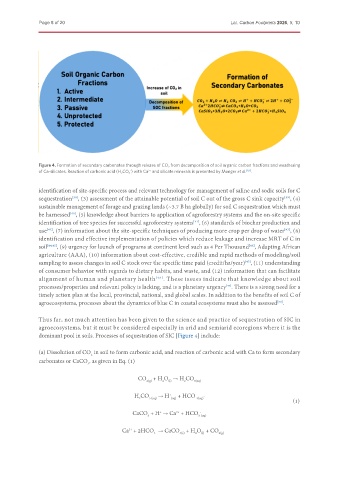
               Figure 4. Formation of secondary carbonates through release of CO 2  from decomposition of soil organic carbon fractions and weathering
               of Ca-silicates. Reaction of carbonic acid (H 2 CO 3 ) with Ca  and silicate minerals is presented by Monger et al. [52] .
                                               -
                                                     2+
               identification of site-specific process and relevant technology for management of saline and sodic soils for C
               sequestration , (3) assessment of the attainable potential of soil C out of the gross C sink capacity , (4)
                          [38]
                                                                                                     [39]
               sustainable management of forage and grazing lands (~3.7 B ha globally) for soil C sequestration which must
               be harnessed , (5) knowledge about barriers to application of agroforestry systems and the on-site specific
                          [40]
               identification of tree species for successful agroforestry systems , (6) standards of biochar production and
                                                                     [41]
               use , (7) information about the site-specific techniques of producing more crop per drop of water , (8)
                                                                                                     [43]
                 [42]
               identification and effective implementation of policies which reduce leakage and increase MRT of C in
               soil [44,45] , (9) urgency for launch of programs at continent level such as 4 Per Thousand , Adapting African
                                                                                        [46]
               agriculture (AAA), (10) information about cost-effective, credible and rapid methods of modeling/soil
               sampling to assess changes in soil C stock over the specific time paid (credit/ha/year) , (11) understanding
                                                                                       [47]
               of consumer behavior with regards to dietary habits, and waste, and (12) information that can facilitate
               alignment of human and planetary health  [48] . These issues indicate that knowledge about soil
               processes/properties and relevant policy is lacking, and is a planetary urgency . There is a strong need for a
                                                                                [49]
               timely action plan at the local, provincial, national, and global scales. In addition to the benefits of soil C of
               agroecosystems, processes about the dynamics of blue C in coastal ecosystems must also be assessed .
                                                                                                  [50]

               Thus far, not much attention has been given to the science and practice of sequestration of SIC in
               agroecosystems, but it must be considered especially in arid and semiarid ecoregions where it is the
               dominant pool in soils. Processes of sequestration of SIC [Figure 4] include:


               (a) Dissolution of CO  in soil to form carbonic acid, and reaction of carbonic acid with Ca to form secondary
                                 2
               carbonates or CaCO , as given in Eq. (1)
                                3

                                                 CO  + H O  → H CO   3(aq)
                                                          2
                                                            (l)
                                                                  2
                                                    2(g)
                                                H CO 3 (aq)  → H  + HCO - 3(aq) -                                                   (1)
                                                            +
                                                  2
                                                             (aq)
                                                CaCO  + H  → Ca  + HCO 3 (aq)
                                                                       -
                                                               2+
                                                         +
                                                     3
                                            Ca  + 2HCO  → CaCO  + H O  + CO   2(g)
                                                        -
                                              2+
                                                                      2
                                                                        (l)
                                                                3(s)
                                                       3

