


Page 93 - Read online
P. 93
Page 10 of 20                                                      Lal. Carbon Footprints 2026, 5, 10


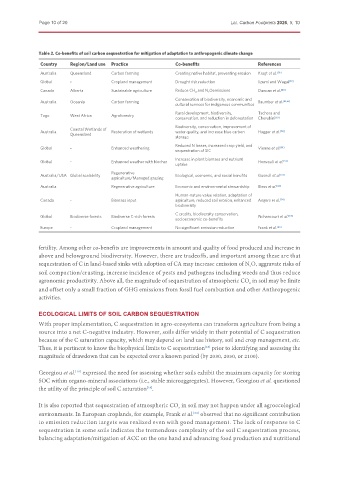
               Table 2. Co-benefits of soil carbon sequestration for mitigation of adaptation to anthropogenic climate change
               Country    Region/Land use  Practice            Co-benefits                  References

               Australia  Queensland    Carbon farming         Creating native habitat, preventing erosion  Kragt et al. [58]
               Global     -             Cropland management    Drought risk reduction       Iizumi and Wagai [59]
               Canada     Alberta       Sustainable agriculture  Reduce CH 4  and N 2 Oemissions  Duncan et al. [60]
                                                               Conservation of biodiversity, economic and
               Australia  Oceania       Carbon farming                                      Baumber et al. [61,62]
                                                               cultural services for indigenous communities
                                                               Rural development, biodiversity,  Tschora and
               Togo       West Africa   Agroforestry
                                                               conservation, and reduction in deforestation  Cherubini [63]
                                                               Biodiversity, conservation, improvement of
                          Coastal Wetlands of
               Australia                Restoration of wetlands  water quality, and increase blue carbon  Hagger et al. [50]
                          Queensland
                                                               storage
                                                               Reduced N losses, increased crop yield, and
               Global     -             Enhanced weathering                                 Vienne et al. [64]
                                                               sequestration of SIC
                                                               Increase in plant biomass and nutrient
               Global     -             Enhanced weather with biochar                       Honvault et al. [53]
                                                               uptake
                                        Regenerative
               Australia/USA Global scalability                Ecological, economic, and social benefits  Gosnell et al. [65]
                                        agriculture/Managed grazing
               Australia                Regenerative agriculture  Economic and environmental stewardship  Bless et al. [66]
                                                               Human-nature value relation, adaptation of
               Canada     -             Biomass input          agriculture, reduced soil erosion, enhanced  Angers et al. [54]
                                                               biodiversity
                                                               C credits, biodiversity conservation,
               Global     Biodiverse forests  Biodiverse C-rich forests                     Pichancourt et al. [67]
                                                               socioeconomic co-benefits
               Europe     -             Cropland management    No significant emission reduction  Frank et al. [68]


               fertility. Among other co-benefits are improvements in amount and quality of food produced and increase in
               above and belowground biodiversity. However, there are tradeoffs, and important among these are that
               sequestration of C in land-based sinks with adoption of CA may increase emission of N O, aggravate risks of
                                                                                         2
               soil compaction/crusting, increase incidence of pests and pathogens including weeds and thus reduce
               agronomic productivity. Above all, the magnitude of sequestration of atmospheric CO  in soil may be finite
                                                                                         2
               and offset only a small fraction of GHG emissions from fossil fuel combustion and other Anthropogenic
               activities.


               ECOLOGICAL LIMITS OF SOIL CARBON SEQUESTRATION
               With proper implementation, C sequestration in agro-ecosystems can transform agriculture from being a
               source into a net C-negative industry. However, soils differ widely in their potential of C sequestration
               because of the C saturation capacity, which may depend on land use history, soil and crop management, etc.
               Thus, it is pertinent to know the biophysical limits to C sequestration  prior to identifying and assessing the
                                                                         [18]
               magnitude of drawdown that can be expected over a known period (by 2030, 2050, or 2100).


               Georgiou et al.  expressed the need for assessing whether soils exhibit the maximum capacity for storing
                            [18]
               SOC within organo-mineral associations (i.e., stable microaggregates). However, Georgiou et al. questioned
               the utility of the principle of soil C saturation .
                                                     [18]

               It is also reported that sequestration of atmospheric CO  in soil may not happen under all agroecological
                                                                2
               environments. In European croplands, for example, Frank et al.  observed that no significant contribution
                                                                     [68]
               to emission reduction targets was realized even with good management. The lack of response to C
               sequestration in some soils indicates the tremendous complexity of the soil C sequestration process,
               balancing adaptation/mitigation of ACC on the one hand and advancing food production and nutritional

