


Page 95 - Read online
P. 95
Page 12 of 20                                                      Lal. Carbon Footprints 2026, 5, 10


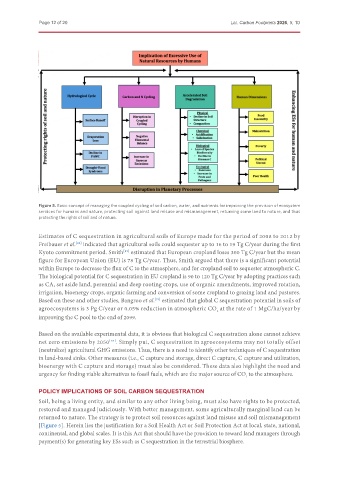
               Figure 5. Basic concept of managing the coupled cycling of soil carbon, water, and nutrients for improving the provision of ecosystem
               services for humans and nature, protecting soil against land misuse and mismanagement, returning some land to nature, and thus
               protecting the rights of soil and of nature.


               Estimates of C sequestration in agricultural soils of Europe made for the period of 2008 to 2012 by
               Freibauer et al.  indicated that agricultural soils could sequester up to 16 to 19 Tg C/year during the first
                            [82]
               Kyoto commitment period. Smith  estimated that European cropland loses 300 Tg C/year but the mean
                                            [83]
               figure for European Union (EU) is 78 Tg C/year. Thus, Smith argued that there is a significant potential
               within Europe to decrease the flux of C to the atmosphere, and for cropland soil to sequester atmospheric C.
               The biological potential for C sequestration in EU cropland is 90 to 120 Tg C/year by adopting practices such
               as CA, set aside land, perennial and deep rooting crops, use of organic amendments, improved rotation,
               irrigation, bioenergy crops, organic farming and conversion of some cropland to grazing land and pastures.
               Based on these and other studies, Bangroo et al.  estimated that global C sequestration potential in soils of
                                                       [73]
               agroecosystems is 3 Pg C/year or 0.05% reduction in atmospheric CO  at the rate of 1 MgC/ha/year by
                                                                             2
               improving the C pool to the end of 2099.

               Based on the available experimental data, it is obvious that biological C sequestration alone cannot achieve
               net zero emissions by 2050 . Simply put, C sequestration in agroecosystems may not totally offset
                                       [84]
               (neutralize) agricultural GHG emissions. Thus, there is a need to identify other techniques of C sequestration
               in land-based sinks. Other measures (i.e., C capture and storage, direct C capture, C capture and utilization,
               bioenergy with C capture and storage) must also be considered. These data also highlight the need and
               urgency for finding viable alternatives to fossil fuels, which are the major source of CO  to the atmosphere.
                                                                                       2

               POLICY IMPLICATIONS OF SOIL CARBON SEQUESTRATION
               Soil, being a living entity, and similar to any other living being, must also have rights to be protected,
               restored and managed judiciously. With better management, some agriculturally marginal land can be
               returned to nature. The strategy is to protect soil resources against land misuse and soil mismanagement
               [Figure 5]. Herein lies the justification for a Soil Health Act or Soil Protection Act at local, state, national,
               continental, and global scales. It is this Act that should have the provision to reward land managers through
               payment(s) for generating key ESs such as C sequestration in the terrestrial biosphere.

