


Page 90 - Read online
P. 90
Lal. Carbon Footprints 2026, 5, 10                                                Page 7 of 20


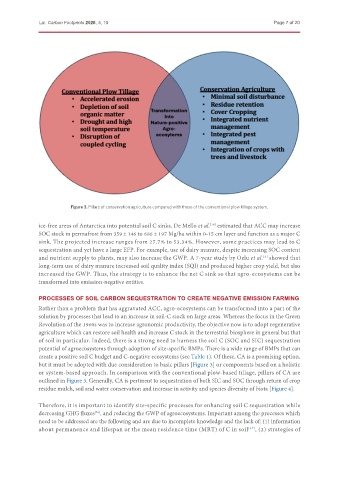
                          Figure 3. Pillars of conservation agriculture compared with those of the conventional plow tillage system.

               ice-free areas of Antarctica into potential soil C sinks. De Mello et al.  estimated that ACC may increase
                                                                           [19]
               SOC stock in permafrost from 359 ± 146 to 686 ± 197 Mg/ha within 0-15 cm layer and function as a major C
               sink. The projected increase ranges from 27.7% to 53.34%. However, some practices may lead to C
               sequestration and yet have a large EFP. For example, use of dairy manure, despite increasing SOC content
               and nutrient supply to plants, may also increase the GWP. A 7-year study by Ozlu et al.  showed that
                                                                                             [3]
               long-term use of dairy manure increased soil quality index (SQI) and produced higher crop yield, but also
               increased the GWP. Thus, the strategy is to enhance the net C sink so that agro-ecosystems can be
               transformed into emission-negative entities.

               PROCESSES OF SOIL CARBON SEQUESTRATION TO CREATE NEGATIVE EMISSION FARMING
               Rather than a problem that has aggravated ACC, agro-ecosystems can be transformed into a part of the
               solution by processes that lead to an increase in soil-C stock on large areas. Whereas the focus in the Green
               Revolution of the 1960s was to increase agronomic productivity, the objective now is to adopt regenerative
               agriculture which can restore soil health and increase C stock in the terrestrial biosphere in general but that
               of soil in particular. Indeed, there is a strong need to harness the soil C (SOC and SIC) sequestration
               potential of agroecosystems through adoption of site-specific BMPs. There is a wide range of BMPs that can
               create a positive soil C budget and C-negative ecosystems (see Table 1). Of these, CA is a promising option,
               but it must be adopted with due consideration to basic pillars [Figure 3] or components based on a holistic
               or system-based approach. In comparison with the conventional plow-based tillage, pillars of CA are
               outlined in Figure 3. Generally, CA is pertinent to sequestration of both SIC and SOC through return of crop
               residue mulch, soil and water conservation and increase in activity and species diversity of biota [Figure 4].


               Therefore, it is important to identify site-specific processes for enhancing soil C sequestration while
               decreasing GHG fluxes , and reducing the GWP of agroecosystems. Important among the processes which
                                  [36]
               need to be addressed are the following and are due to incomplete knowledge and the lack of: (1) information
               about permanence and lifespan or the mean residence time (MRT) of C in soil , (2) strategies of
                                                                                        [37]

