


Page 87 - Read online
P. 87
Page 4 of 20                                                       Lal. Carbon Footprints 2026, 5, 10


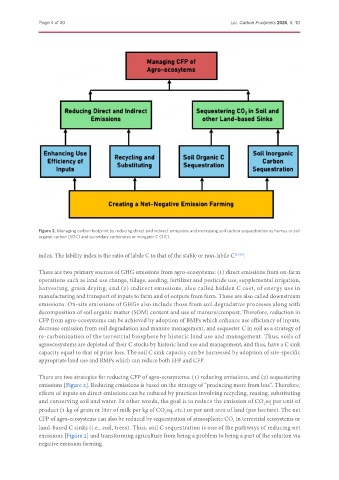
               Figure 2. Managing carbon footprint by reducing direct and indirect emissions and increasing soil carbon sequestration as humus or soil
               organic carbon (SOC) and secondary carbonates or inorganic C (SIC).


               index. The lability index is the ratio of labile C to that of the stable or non-labile C [11,12] .

               There are two primary sources of GHG emissions from agro-ecosystems: (1) direct emissions from on-farm
               operations such as land use change, tillage, seeding, fertilizer and pesticide use, supplemental irrigation,
               harvesting, grain drying, and (2) indirect emissions, also called hidden C cost, of energy use in
               manufacturing and transport of inputs to farm and of outputs from farm. These are also called downstream
               emissions. On-site emissions of GHGs also include those from soil degradative processes along with
               decomposition of soil organic matter (SOM) content and use of manure/compost. Therefore, reduction in
               CFP from agro-ecosystems can be achieved by adoption of BMPs which enhance use efficiency of inputs,
               decrease emission from soil degradation and manure management, and sequester C in soil as a strategy of
               re-carbonization of the terrestrial biosphere by historic land use and management. Thus, soils of
               agroecosystems are depleted of their C stocks by historic land use and management, and thus, have a C sink
               capacity equal to that of prior loss. The soil C sink capacity can be harnessed by adoption of site-specific
               appropriate land use and BMPs which can reduce both EFP and CFP.


               There are two strategies for reducing CFP of agro-ecosystems: (1) reducing emissions, and (2) sequestering
               emissions [Figure 2]. Reducing emissions is based on the strategy of “producing more from less”. Therefore,
               effects of inputs on direct emissions can be reduced by practices involving recycling, reusing, substituting
               and conserving soil and water. In other words, the goal is to reduce the emission of CO eq per unit of
                                                                                              2
               product (1 kg of grain or liter of milk per kg of CO eq, etc.) or per unit area of land (per hectare). The net
                                                           2
               CFP of agro-ecosystems can also be reduced by sequestration of atmospheric CO  in terrestrial ecosystems or
                                                                                   2
               land-based C sinks (i.e., soil, trees). Thus, soil C sequestration is one of the pathways of reducing net
               emissions [Figure 2] and transforming agriculture from being a problem to being a part of the solution via
               negative emission farming.

