


Page 86 - Read online
P. 86
Lal. Carbon Footprints 2026, 5, 10                                                Page 3 of 20


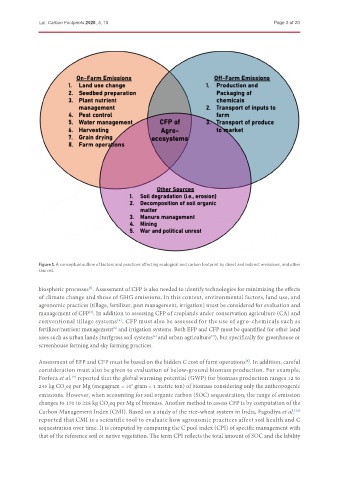
               Figure 1. A conceptual outline of factors and practices affecting ecological and carbon footprint by direct and indirect emissions, and other
               sources.

               biospheric processes . Assessment of CFP is also needed to identify technologies for minimizing the effects
                                [2]
               of climate change and those of GHG emissions. In this context, environmental factors, land use, and
               agronomic practices (tillage, fertilizer, pest management, irrigation) must be considered for evaluation and
               management of CFP . In addition to assessing CFP of croplands under conservation agriculture (CA) and
                                [3]
               conventional tillage systems , CFP must also be assessed for the use of agro-chemicals such as
                                          [4]
               fertilizer/nutrient management  and irrigation systems. Both EFP and CFP must be quantified for other land
                                         [5]
               uses such as urban lands (turfgrass soil systems  and urban agriculture ), but specifically for greenhouse or
                                                                           [7]
                                                       [6]
               screenhouse farming and sky farming practices.
               Assessment of EFP and CFP must be based on the hidden C cost of farm operations . In addition, careful
                                                                                       [8]
               consideration must also be given to evaluation of below-ground biomass production. For example,
               Forfora et al.  reported that the global warming potential (GWP) for biomass production ranges 12 to
                          [9]
               245 kg CO eq per Mg (megagram = 10  gram = 1 metric ton) of biomass considering only the anthropogenic
                                               6
                        2
               emissions. However, when accounting for soil organic carbon (SOC) sequestration, the range of emission
               changes to 170 to 228 kg CO eq per Mg of biomass. Another method to assess CFP is by computation of the
                                       2
               Carbon Management Index (CMI). Based on a study of the rice-wheat system in India, Fagodiya et al. [10]
               reported that CMI is a scientific tool to evaluate how agronomic practices affect soil health and C
               sequestration over time. It is computed by comparing the C pool index (CPI) of specific management with
               that of the reference soil or native vegetation. The term CPI reflects the total amount of SOC and the lability

