


Page 89 - Read online
P. 89
Page 6 of 20                                                       Lal. Carbon Footprints 2026, 5, 10


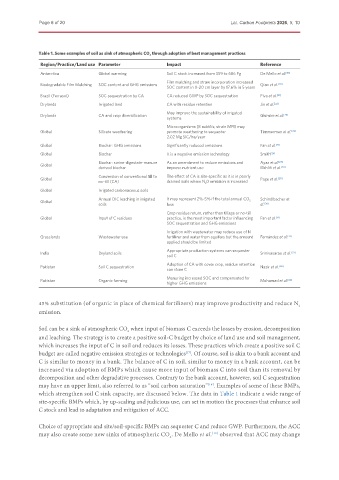
               Table 1. Some examples of soil as sink of atmospheric CO 2  through adoption of best management practices

               Region/Practice/Land use Parameter           Impact                          Reference
               Antarctica           Global warming          Soil C stock increased from 359 to 686 Pg  De Mello et al. [19]
                                                            Film mulching and straw incorporation increased
               Biodegradable Film Mulching  SOC content and GHG emissions                   Qian et al. [20]
                                                            SOC content in 0-20 cm layer by 17.6% in 5 years
               Brazil (Ferrasol)    SOC sequestration by CA  CA reduced GWP by SOC sequestration  Piva et al. [21]
               Drylands             Irrigated land          CA with residue retention       Jin et al. [22]
                                                            May improve the sustainability of irrigated
               Drylands             CA and crop diversification                             Ghimire et al. [23]
                                                            systems
                                                            Microorganisms (B subtilis, strain MPI) may
               Global               Silicate weathering     promote weathering to sequester  Timmerman et al. [24]
                                                            2.02 Mg SIC/ha/year
               Global               Biochar: GHG emissions  Significantly reduced emissions  Fan et al. [25]
               Global               Biochar                 It is a negative emission technology  Smith [26]
                                    Biochar: swine-digestate-manure  As an amendment to reduce emissions and  Ayaz et al. [27]
               Global
                                    derived biochar         improve nutrient use            Elkhlifi et al. [28]
                                    Conversion of conventional till to  The effect of CA is site-specific as it is in poorly
               Global                                                                       Page et al. [29]
                                    no-till (CA)            drained soils where N 2 0 emission is increased
               Global               Irrigated carbonaceous soils
                                    Annual DIC leaching in irrigated  It may represent 2%-5% if the total annual CO 2  Schindlbacher et
               Global
                                    soils                   loss                            al. [30]
                                                            Crop residue return, rather than tillage or no-till
               Global               Input of C residues     practice, is the most important factor influencing  Fan et al. [31]
                                                            SOC sequestration and GHG emissions
                                                            Irrigation with wastewater may reduce use of N
               Grasslands           Wastewater use          fertilizer and water from aquifers but the amount  Fernández et al. [32]
                                                            applied should be limited
                                                            Appropriate production systems can sequester
               India                Dryland soils                                           Srinivasarao et al. [33]
                                                            soil C
                                                            Adoption of CA with cover crop, residue retention
               Pakistan             Soil C sequestration                                    Nazir et al. [34]
                                                            can store C
                                                            Manuring increased SOC and compensated for
               Pakistan             Organic farming                                         Mohamad et al. [35]
                                                            higher GHG emissions

               45% substitution (of organic in place of chemical fertilizers) may improve productivity and reduce N 2
               emission.


               Soil can be a sink of atmospheric CO  when input of biomass C exceeds the losses by erosion, decomposition
                                              2
               and leaching. The strategy is to create a positive soil-C budget by choice of land use and soil management,
               which increases the input of C in soil and reduces its losses. These practices which create a positive soil C
               budget are called negative emission strategies or technologies . Of course, soil is akin to a bank account and
                                                                  [17]
               C is similar to money in a bank. The balance of C in soil, similar to money in a bank account, can be
               increased via adoption of BMPs which cause more input of biomass C into soil than its removal by
               decomposition and other degradative processes. Contrary to the bank account, however, soil C sequestration
               may have an upper limit, also referred to as “soil carbon saturation” . Examples of some of these BMPs,
                                                                          [18]
               which strengthen soil C sink capacity, are discussed below. The data in Table 1 indicate a wide range of
               site-specific BMPs which, by up-scaling and judicious use, can set in motion the processes that enhance soil
               C stock and lead to adaptation and mitigation of ACC.

               Choice of appropriate and site/soil-specific BMPs can sequester C and reduce GWP. Furthermore, the ACC
               may also create some new sinks of atmospheric CO . De Mello et al.  observed that ACC may change
                                                                           [19]
                                                             2

