


Page 37 - Read Online
P. 37
Tong et al. Carbon Footprints 2025;4:2    https://dx.doi.org/10.20517/cf.2024.44  Page 11 of 18

               Table 2. The input-output subsystem decomposition of carbon emission in China’s automobile manufacturing sector
                                 Final demands      Capital formation      Export            In total
                            tonne         %     tonne          %     tonne       %    tonne         %
                Own internal  105,647.7   0.02  268,000.5      0.06  112,908.5   0.03  486,556.6    0.11
                Feedback    1,929.9       0.00  4,470.7        0.00  3,629.1     0.00  10,029.7     0.00
                Spillover   104,265,073.3  23.98  283,367,244.8  65.18  41,859,411.0  9.63  429,491,729.1  98.79
                Scale       1,170,994.3   0.27  3,200,198.7    0.74  404,805.1   0.09  4,775,998.1  1.10

               Note: “%” represents the proportion of emissions of a specific component relative to the total emissions.


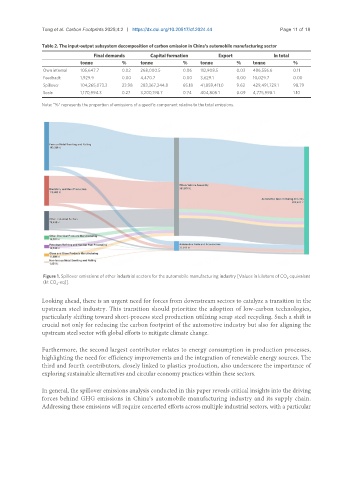
                Figure 1. Spillover emissions of other industrial sectors for the automobile manufacturing industry [Values in kilotons of CO  equivalent
                                                                                                  2
                (kt CO -eq)].
                    2
               Looking ahead, there is an urgent need for forces from downstream sectors to catalyze a transition in the
               upstream steel industry. This transition should prioritize the adoption of low-carbon technologies,
               particularly shifting toward short-process steel production utilizing scrap steel recycling. Such a shift is
               crucial not only for reducing the carbon footprint of the automotive industry but also for aligning the
               upstream steel sector with global efforts to mitigate climate change.


               Furthermore, the second largest contributor relates to energy consumption in production processes,
               highlighting the need for efficiency improvements and the integration of renewable energy sources. The
               third and fourth contributors, closely linked to plastics production, also underscore the importance of
               exploring sustainable alternatives and circular economy practices within these sectors.

               In general, the spillover emissions analysis conducted in this paper reveals critical insights into the driving
               forces behind GHG emissions in China’s automobile manufacturing industry and its supply chain.
               Addressing these emissions will require concerted efforts across multiple industrial sectors, with a particular

