


Page 39 - Read Online
P. 39
Tong et al. Carbon Footprints 2025;4:2    https://dx.doi.org/10.20517/cf.2024.44  Page 13 of 18


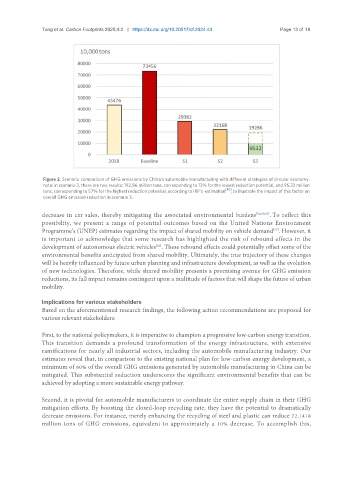
                Figure 2. Scenario comparison of GHG emissions by China’s automobile manufacturing with different strategies of circular economy.
                note: in scenario 3, there are two results: 192.86 million tons, corresponding to 13% for the lowest reduction potential, and 95.32 million
                                                                             [40]
                tons, corresponding to 57% for the highest reduction potential, according to IRP’s estimation  , to illustrate the impact of this factor on
                overall GHG emission reduction in scenario 3.
               decrease in car sales, thereby mitigating the associated environmental burdens [56,60,61] . To reflect this
               possibility, we present a range of potential outcomes based on the United Nations Environment
               Programme’s (UNEP) estimates regarding the impact of shared mobility on vehicle demand . However, it
                                                                                             [57]
               is important to acknowledge that some research has highlighted the risk of rebound effects in the
               development of autonomous electric vehicles . These rebound effects could potentially offset some of the
                                                      [62]
               environmental benefits anticipated from shared mobility. Ultimately, the true trajectory of these changes
               will be heavily influenced by future urban planning and infrastructure development, as well as the evolution
               of new technologies. Therefore, while shared mobility presents a promising avenue for GHG emission
               reductions, its full impact remains contingent upon a multitude of factors that will shape the future of urban
               mobility.

               Implications for various stakeholders
               Based on the aforementioned research findings, the following action recommendations are proposed for
               various relevant stakeholders:


               First, to the national policymakers, it is imperative to champion a progressive low-carbon energy transition.
               This transition demands a profound transformation of the energy infrastructure, with extensive
               ramifications for nearly all industrial sectors, including the automobile manufacturing industry. Our
               estimates reveal that, in comparison to the existing national plan for low-carbon energy development, a
               minimum of 60% of the overall GHG emissions generated by automobile manufacturing in China can be
               mitigated. This substantial reduction underscores the significant environmental benefits that can be
               achieved by adopting a more sustainable energy pathway.

               Second, it is pivotal for automobile manufacturers to coordinate the entire supply chain in their GHG
               mitigation efforts. By boosting the closed-loop recycling rate, they have the potential to dramatically
               decrease emissions. For instance, merely enhancing the recycling of steel and plastic can reduce 72.1418
               million tons of GHG emissions, equivalent to approximately a 10% decrease. To accomplish this,

