


Page 34 - Read Online
P. 34
Page 8 of 18                     Tong et al. Carbon Footprints 2025;4:2    https://dx.doi.org/10.20517/cf.2024.44

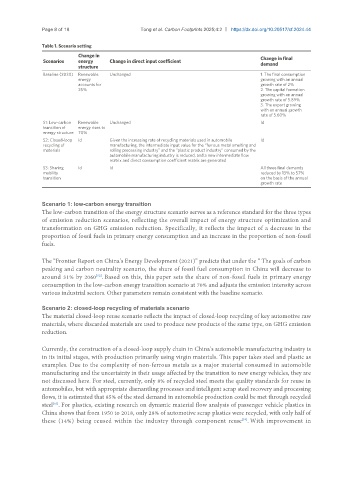
               Table 1. Scenario setting
                           Change in
                Scenarios  energy     Change in direct input coefficient                 Change in final
                                                                                         demand
                           structure
                Baseline (2030)  Renewable   Unchanged                                   1. The final consumption
                           energy                                                        growing with an annual
                           accounts for                                                  growth rate of 2%
                           25%                                                           2. The capital formation
                                                                                         growing with an annual
                                                                                         growth rate of 5.89%
                                                                                         3. The export growing
                                                                                         with an annual growth
                                                                                         rate of 5.60%
                S1: Low-carbon   Renewable   Unchanged                                   Id
                transition of   energy rises to
                energy structure  70%
                S2: Closed-loop   Id  Given the increasing rate of recycling materials used in automobile   Id
                recycling of          manufacturing, the intermediate input value for the “ferrous metal smelting and
                materials             rolling processing industry” and the “plastic product industry” consumed by the
                                      automobile manufacturing industry is reduced, and a new intermediate flow
                                      matrix and direct consumption coefficient matrix are generated
                S3: Sharing   Id      Id                                                 All three final demands
                mobility                                                                 reduced by 13% to 57%
                transition                                                               on the basis of the annual
                                                                                         growth rate


               Scenario 1: low-carbon energy transition
               The low-carbon transition of the energy structure scenario serves as a reference standard for the three types
               of emission reduction scenarios, reflecting the overall impact of energy structure optimization and
               transformation on GHG emission reduction. Specifically, it reflects the impact of a decrease in the
               proportion of fossil fuels in primary energy consumption and an increase in the proportion of non-fossil
               fuels.


               The “Frontier Report on China’s Energy Development (2021)” predicts that under the “ The goals of carbon
               peaking and carbon neutrality scenario, the share of fossil fuel consumption in China will decrease to
                                 [52]
               around 31% by 2060 . Based on this, this paper sets the share of non-fossil fuels in primary energy
               consumption in the low-carbon energy transition scenario at 70% and adjusts the emission intensity across
               various industrial sectors. Other parameters remain consistent with the baseline scenario.

               Scenario 2: closed-loop recycling of materials scenario
               The material closed-loop reuse scenario reflects the impact of closed-loop recycling of key automotive raw
               materials, where discarded materials are used to produce new products of the same type, on GHG emission
               reduction.


               Currently, the construction of a closed-loop supply chain in China’s automobile manufacturing industry is
               in its initial stages, with production primarily using virgin materials. This paper takes steel and plastic as
               examples. Due to the complexity of non-ferrous metals as a major material consumed in automobile
               manufacturing and the uncertainty in their usage affected by the transition to new energy vehicles, they are
               not discussed here. For steel, currently, only 8% of recycled steel meets the quality standards for reuse in
               automobiles, but with appropriate dismantling processes and intelligent scrap steel recovery and processing
               flows, it is estimated that 85% of the steel demand in automobile production could be met through recycled
                   [53]
               steel . For plastics, existing research on dynamic material flow analysis of passenger vehicle plastics in
               China shows that from 1950 to 2018, only 28% of automotive scrap plastics were recycled, with only half of
                                                                                   [54]
               these (14%) being reused within the industry through component reuse . With improvement in

