


Page 32 - Read Online
P. 32
Page 6 of 18                     Tong et al. Carbon Footprints 2025;4:2    https://dx.doi.org/10.20517/cf.2024.44


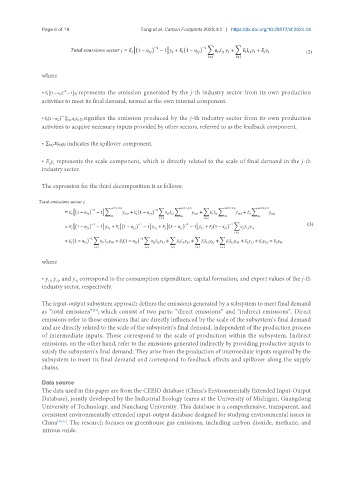
               where


               •            represents the emission generated by the j-th industry sector from its own production
               activities to meet its final demand, termed as the own internal component.


               •             signifies the emission produced by the j-th industry sector from its own production
               activities to acquire necessary inputs provided by other sectors, referred to as the feedback component.

               •          indicates the spillover component.


               • E y  represents the scale component, which is directly related to the scale of final demand in the j-th
                  j j
               industry sector.

               The expression for the third decomposition is as follows:


               where


               • y , y , and y  correspond to the consumption expenditure, capital formation, and export values of the j-th
                          3j
                    2j
                 1j
               industry sector, respectively.
               The input-output subsystem approach defines the emissions generated by a subsystem to meet final demand
                                [44]
               as “total emissions” , which consist of two parts: “direct emissions” and “indirect emissions”. Direct
               emissions refer to those emissions that are directly influenced by the scale of the subsystem’s final demand
               and are directly related to the scale of the subsystem’s final demand, independent of the production process
               of intermediate inputs. These correspond to the scale of production within the subsystem. Indirect
               emissions, on the other hand, refer to the emissions generated indirectly by providing productive inputs to
               satisfy the subsystem’s final demand. They arise from the production of intermediate inputs required by the
               subsystem to meet its final demand and correspond to feedback effects and spillover along the supply
               chains.


               Data source
               The data used in this paper are from the CEEIO database (China’s Environmentally Extended Input-Output
               Database), jointly developed by the Industrial Ecology teams at the University of Michigan, Guangdong
               University of Technology, and Nanchang University. This database is a comprehensive, transparent, and
               consistent environmentally extended input-output database designed for studying environmental issues in
               China [46,47] . The research focuses on greenhouse gas emissions, including carbon dioxide, methane, and
               nitrous oxide.

