


Page 23 - Read Online
P. 23
Hao et al. Carbon Footprints 2024;3:15  https://dx.doi.org/10.20517/cf.2024.24  Page 19 of 22


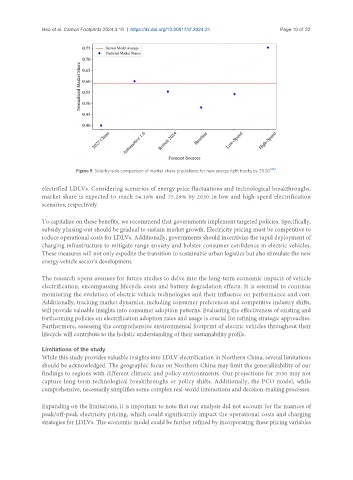
                           Figure 9. Side-by-side comparison of market share predictions for new energy light trucks by 2030 [48] .

               electrified LDLVs. Considering scenarios of energy price fluctuations and technological breakthroughs,
               market share is expected to reach 54.18% and 75.29% by 2030 in low and high-speed electrification
               scenarios, respectively.


               To capitalize on these benefits, we recommend that governments implement targeted policies. Specifically,
               subsidy phasing-out should be gradual to sustain market growth. Electricity pricing must be competitive to
               reduce operational costs for LDLVs. Additionally, governments should incentivize the rapid deployment of
               charging infrastructure to mitigate range anxiety and bolster consumer confidence in electric vehicles.
               These measures will not only expedite the transition to sustainable urban logistics but also stimulate the new
               energy vehicle sector’s development.


               The research opens avenues for future studies to delve into the long-term economic impacts of vehicle
               electrification, encompassing lifecycle costs and battery degradation effects. It is essential to continue
               monitoring the evolution of electric vehicle technologies and their influence on performance and cost.
               Additionally, tracking market dynamics, including consumer preferences and competitive industry shifts,
               will provide valuable insights into consumer adoption patterns. Evaluating the effectiveness of existing and
               forthcoming policies on electrification adoption rates and usage is crucial for refining strategic approaches.
               Furthermore, assessing the comprehensive environmental footprint of electric vehicles throughout their
               lifecycle will contribute to the holistic understanding of their sustainability profile.

               Limitations of the study
               While this study provides valuable insights into LDLV electrification in Northern China, several limitations
               should be acknowledged. The geographic focus on Northern China may limit the generalizability of our
               findings to regions with different climatic and policy environments. Our projections for 2030 may not
               capture long-term technological breakthroughs or policy shifts. Additionally, the PCO model, while
               comprehensive, necessarily simplifies some complex real-world interactions and decision-making processes.


               Expanding on the limitations, it is important to note that our analysis did not account for the nuances of
               peak/off-peak electricity pricing, which could significantly impact the operational costs and charging
               strategies for LDLVs. The economic model could be further refined by incorporating these pricing variables

