


Page 22 - Read Online
P. 22
Page 18 of 22                     Hao et al. Carbon Footprints 2024;3:15  https://dx.doi.org/10.20517/cf.2024.24


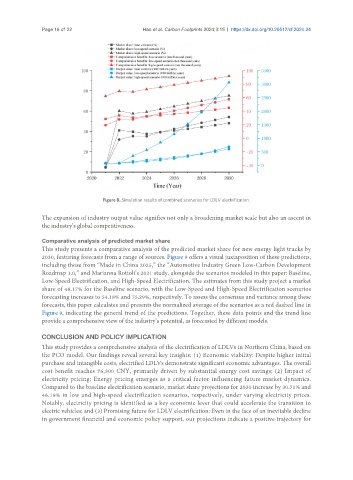
                                    Figure 8. Simulation results of combined scenarios for LDLV electrification.

               The expansion of industry output value signifies not only a broadening market scale but also an ascent in
               the industry’s global competitiveness.

               Comparative analysis of predicted market share
               This study presents a comparative analysis of the predicted market share for new energy light trucks by
               2030, featuring forecasts from a range of sources. Figure 9 offers a visual juxtaposition of these predictions,
               including those from “Made in China 2025,” the “Automotive Industry Green Low-Carbon Development
               Roadmap 1.0,” and Marianna Rottoli’s 2021 study, alongside the scenarios modeled in this paper: Baseline,
               Low-Speed Electrification, and High-Speed Electrification. The estimates from this study project a market
               share of 48.17% for the Baseline scenario, with the Low-Speed and High-Speed Electrification scenarios
               forecasting increases to 54.18% and 75.29%, respectively. To assess the consensus and variance among these
               forecasts, this paper calculates and presents the normalized average of the scenarios as a red dashed line in
               Figure 9, indicating the general trend of the predictions. Together, these data points and the trend line
               provide a comprehensive view of the industry’s potential, as forecasted by different models.

               CONCLUSION AND POLICY IMPLICATION
               This study provides a comprehensive analysis of the electrification of LDLVs in Northern China, based on
               the PCO model. Our findings reveal several key insights: (1) Economic viability: Despite higher initial
               purchase and intangible costs, electrified LDLVs demonstrate significant economic advantages. The overall
               cost benefit reaches 76,300 CNY, primarily driven by substantial energy cost savings; (2) Impact of
               electricity pricing: Energy pricing emerges as a critical factor influencing future market dynamics.
               Compared to the baseline electrification scenario, market share projections for 2030 increase by 30.71% and
               46.19% in low and high-speed electrification scenarios, respectively, under varying electricity prices.
               Notably, electricity pricing is identified as a key economic lever that could accelerate the transition to
               electric vehicles; and (3) Promising future for LDLV electrification: Even in the face of an inevitable decline
               in government financial and economic policy support, our projections indicate a positive trajectory for

