


Page 12 - Read Online
P. 12
Page 8 of 22                      Hao et al. Carbon Footprints 2024;3:15  https://dx.doi.org/10.20517/cf.2024.24

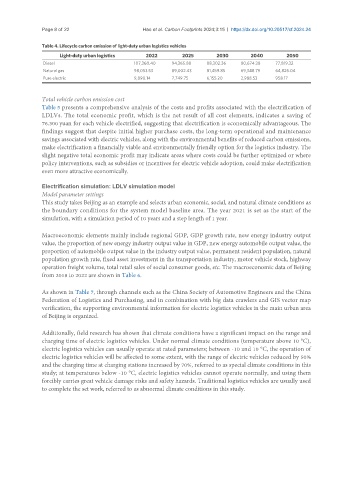
               Table 4. Lifecycle carbon emission of light-duty urban logistics vehicles
                     Light-duty urban logistics   2022        2025        2030        2040        2050
                Diesel                        107,360.40   94,365.88   88,302.36  80,674.38   77,819.32
                Natural gas                   98,053.53    89,002.43   81,459.85  69,348.79   64,826.04
                Pure electric                 9,890.14     7,749.75    6,155.20   2,988.53    958.17


               Total vehicle carbon emission cost
               Table 5 presents a comprehensive analysis of the costs and profits associated with the electrification of
               LDLVs. The total economic profit, which is the net result of all cost elements, indicates a saving of
               76.300 yuan for each vehicle electrified, suggesting that electrification is economically advantageous. The
               findings suggest that despite initial higher purchase costs, the long-term operational and maintenance
               savings associated with electric vehicles, along with the environmental benefits of reduced carbon emissions,
               make electrification a financially viable and environmentally friendly option for the logistics industry. The
               slight negative total economic profit may indicate areas where costs could be further optimized or where
               policy interventions, such as subsidies or incentives for electric vehicle adoption, could make electrification
               even more attractive economically.


               Electrification simulation: LDLV simulation model
               Model parameter settings
               This study takes Beijing as an example and selects urban economic, social, and natural climate conditions as
               the boundary conditions for the system model baseline area. The year 2021 is set as the start of the
               simulation, with a simulation period of 10 years and a step length of 1 year.


               Macroeconomic elements mainly include regional GDP, GDP growth rate, new energy industry output
               value, the proportion of new energy industry output value in GDP, new energy automobile output value, the
               proportion of automobile output value in the industry output value, permanent resident population, natural
               population growth rate, fixed asset investment in the transportation industry, motor vehicle stock, highway
               operation freight volume, total retail sales of social consumer goods, etc. The macroeconomic data of Beijing
               from 2018 to 2022 are shown in Table 6.


               As shown in Table 7, through channels such as the China Society of Automotive Engineers and the China
               Federation of Logistics and Purchasing, and in combination with big data crawlers and GIS vector map
               verification, the supporting environmental information for electric logistics vehicles in the main urban area
               of Beijing is organized.

               Additionally, field research has shown that climate conditions have a significant impact on the range and
               charging time of electric logistics vehicles. Under normal climate conditions (temperature above 10 °C),
               electric logistics vehicles can usually operate at rated parameters; between -10 and 10 °C, the operation of
               electric logistics vehicles will be affected to some extent, with the range of electric vehicles reduced by 50%
               and the charging time at charging stations increased by 70%, referred to as special climate conditions in this
               study; at temperatures below -10 °C, electric logistics vehicles cannot operate normally, and using them
               forcibly carries great vehicle damage risks and safety hazards. Traditional logistics vehicles are usually used
               to complete the set work, referred to as abnormal climate conditions in this study.

