


Page 9 - Read Online
P. 9
Li et al. Carbon Footprints 2024;3:6  https://dx.doi.org/10.20517/cf.2023.54     Page 5 of 14

               Table 2. Manufacturing and EOL emissions data of refrigerants and materials
                                                                            Manufacture or disposal
                Stages        Materials                Mass fraction/%
                                                                            CEF/(kg CO /kg)
                                                                                     2
                Manufacture   Foam plastic             9.0%                 3.0
                              Rubber                   4.1%                 3.1
                              Lubricating oil          1.2%                 1.3
                              Steel                    17.0%                2.3
                              Aluminum alloy           57.6%                1.64
                              Copper wire              8.7%                 3.8
                              Copper alloy             2.4%                 3.3
                              R134a                    -                    8
                              R1234yf                  -                    13.7
                              R744                     -                    0.2
                Disposal      Metal                    83.5%                0.17
                              Foam plastic and rubber  12.8%                0.015
                              Refrigerants             -                    2.1


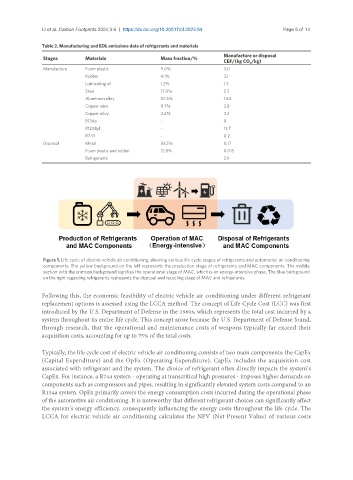
                Figure 1. Life cycle of electric vehicle air conditioning, showing various life cycle stages of refrigerants and automotive air conditioning
                components. The yellow background on the left represents the production stage of refrigerants and MAC components. The middle
                section with the crimson background signifies the operational stage of MAC, which is an energy-intensive phase. The blue background
                on the right regarding refrigerants represents the disposal and recycling stage of MAC and refrigerants.

               Following this, the economic feasibility of electric vehicle air conditioning under different refrigerant
               replacement options is assessed using the LCCA method. The concept of Life Cycle Cost (LCC) was first
               introduced by the U.S. Department of Defense in the 1960s, which represents the total cost incurred by a
               system throughout its entire life cycle. This concept arose because the U.S. Department of Defense found,
               through research, that the operational and maintenance costs of weapons typically far exceed their
               acquisition costs, accounting for up to 75% of the total costs.

               Typically, the life cycle cost of electric vehicle air conditioning consists of two main components: the CapEx
               (Capital Expenditure) and the OpEx (Operating Expenditure). CapEx includes the acquisition cost
               associated with refrigerant and the system. The choice of refrigerant often directly impacts the system’s
               CapEx. For instance, a R744 system - operating at transcritical high pressures - imposes higher demands on
               components such as compressors and pipes, resulting in significantly elevated system costs compared to an
               R134a system. OpEx primarily covers the energy consumption costs incurred during the operational phase
               of the automotive air conditioning. It is noteworthy that different refrigerant choices can significantly affect
               the system’s energy efficiency, consequently influencing the energy costs throughout the life cycle. The
               LCCA for electric vehicle air conditioning calculates the NPV (Net Present Value) of various costs

