


Page 7 - Read Online
P. 7
Li et al. Carbon Footprints 2024;3:6  https://dx.doi.org/10.20517/cf.2023.54     Page 3 of 14

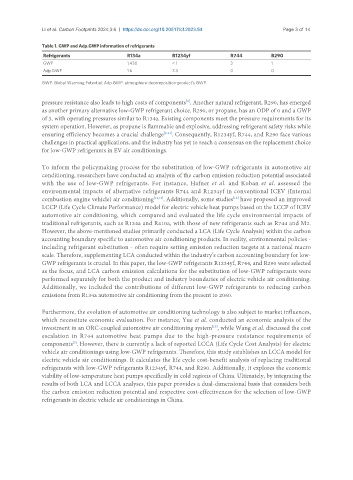
               Table 1. GWP and Adp.GWP information of refrigerants
                Refrigerants                R134a          R1234yf             R744         R290
                GWP                         1,430          < 1                 3            1
                Adp.GWP                     1.6            3.3                 0            0

               GWP: Global Warming Potential; Adp.GWP: atmosphere-decomposition-product’s GWP.


               pressure resistance also leads to high costs of components . Another natural refrigerant, R290, has emerged
                                                                [8]
               as another primary alternative low-GWP refrigerant choice. R290, or propane, has an ODP of 0 and a GWP
               of 3, with operating pressures similar to R134a. Existing components meet the pressure requirements for its
               system operation. However, as propane is flammable and explosive, addressing refrigerant safety risks while
               ensuring efficiency becomes a crucial challenge [9-11] . Consequently, R1234yf, R744, and R290 face various
               challenges in practical applications, and the industry has yet to reach a consensus on the replacement choice
               for low-GWP refrigerants in EV air conditionings.

               To inform the policymaking process for the substitution of low-GWP refrigerants in automotive air
               conditioning, researchers have conducted an analysis of the carbon emission reduction potential associated
               with the use of low-GWP refrigerants. For instance, Hafner et al. and Koban et al. assessed the
               environmental impacts of alternative refrigerants R744 and R1234yf in conventional ICEV (Internal
                                                                                [14]
               combustion engine vehicle) air conditioning [12,13] . Additionally, some studies  have proposed an improved
               LCCP (Life Cycle Climate Performance) model for electric vehicle heat pumps based on the LCCP of ICEV
               automotive air conditioning, which compared and evaluated the life cycle environmental impacts of
               traditional refrigerants, such as R134a and R410a, with those of new refrigerants such as R744 and M2.
               However, the above-mentioned studies primarily conducted a LCA (Life Cycle Analysis) within the carbon
               accounting boundary specific to automotive air conditioning products. In reality, environmental policies -
               including refrigerant substitution - often require setting emission reduction targets at a national macro
               scale. Therefore, supplementing LCA conducted within the industry’s carbon accounting boundary for low-
               GWP refrigerants is crucial. In this paper, the low-GWP refrigerants R1234yf, R744, and R290 were selected
               as the focus, and LCA carbon emission calculations for the substitution of low-GWP refrigerants were
               performed separately for both the product and industry boundaries of electric vehicle air conditioning.
               Additionally, we included the contributions of different low-GWP refrigerants to reducing carbon
               emissions from R134a automotive air conditioning from the present to 2060.


               Furthermore, the evolution of automotive air conditioning technology is also subject to market influences,
               which necessitate economic evaluation. For instance, Yue et al. conducted an economic analysis of the
               investment in an ORC-coupled automotive air conditioning system , while Wang et al. discussed the cost
                                                                        [15]
               escalation in R744 automotive heat pumps due to the high-pressure resistance requirements of
               components . However, there is currently a lack of reported LCCA (Life Cycle Cost Analysis) for electric
                          [7]
               vehicle air conditionings using low-GWP refrigerants. Therefore, this study establishes an LCCA model for
               electric vehicle air conditionings. It calculates the life cycle cost-benefit analysis of replacing traditional
               refrigerants with low-GWP refrigerants R1234yf, R744, and R290. Additionally, it explores the economic
               viability of low-temperature heat pumps specifically in cold regions of China. Ultimately, by integrating the
               results of both LCA and LCCA analyses, this paper provides a dual-dimensional basis that considers both
               the carbon emission reduction potential and respective cost-effectiveness for the selection of low-GWP
               refrigerants in electric vehicle air conditionings in China.

