


Page 8 - Read Online
P. 8
Page 4 of 14                         Li et al. Carbon Footprints 2024;3:6  https://dx.doi.org/10.20517/cf.2023.54

               METHODS
               This section initially outlines the calculation methodologies for carbon emissions from automotive air
               conditioning. Depending on the defined carbon accounting boundaries, the LCA of automotive air
               conditioning can be conducted at two distinct levels: the automotive air conditioning product level and the
               automotive air conditioning fleet level. For the product level, E  is the life cycle carbon emissions of an
                                                                      mac
               automotive air conditioning product, which require consideration of both direct and indirect carbon
               emissions generated throughout its production, transportation, usage, and recycling stages, as illustrated in
               Figure 1. For the fleet level, the E  is the fleet carbon emissions of all automotive air conditioning products
                                           fleet
               at a specific time point, considering the total fleet inventory, distinguishing between vehicles in various
               stages - newly sold, in operation, or retired. Therefore, E  represents the cumulative carbon emissions of
                                                                fleet
               all automotive air conditioning products within the fleet inventory at different life cycle stages . The
                                                                                                    [16]
               distinction between E  and E  lies in their temporal dimensions. E  - reflecting carbon emissions from
                                         fleet
                                  mac
                                                                          mac
               an individual automotive air conditioning product - spans the entire life cycle duration of automotive air
               conditioning , while E  - representing carbon emissions from the whole automotive air conditioning fleet
                          [17]
                                   fleet
               - is calculated at a specific time point (i.e., a particular year).
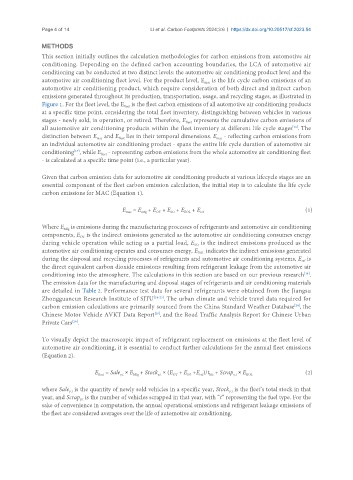
               Given that carbon emission data for automotive air conditioning products at various lifecycle stages are an
               essential component of the fleet carbon emission calculation, the initial step is to calculate the life cycle
               carbon emissions for MAC (Equation 1).

                                          E  = E  + E  + E  + E  + E                                                                      (1)
                                                               EOL
                                                           SO
                                                 mfg
                                                      OT
                                                                     ref
                                           mac
               Where E  is emissions during the manufacturing processes of refrigerants and automotive air conditioning
                       Mfg
               components, E  is the indirect emissions generated as the automotive air conditioning consumes energy
                            OT
               during vehicle operation while acting as a partial load, E  is the indirect emissions produced as the
                                                                   SO
               automotive air conditioning operates and consumes energy, E  indicates the indirect emissions generated
                                                                    EOL
               during the disposal and recycling processes of refrigerants and automotive air conditioning systems, E  is
                                                                                                       ref
               the direct equivalent carbon dioxide emissions resulting from refrigerant leakage from the automotive air
                                                                                                        [14]
               conditioning into the atmosphere. The calculations in this section are based on our previous research .
               The emission data for the manufacturing and disposal stages of refrigerants and air conditioning materials
               are detailed in Table 2. Performance test data for several refrigerants were obtained from the Jiangsu
               Zhongguancun Research Institute of SJTU [18-23] . The urban climate and vehicle travel data required for
               carbon emission calculations are primarily sourced from the China Standard Weather Database , the
                                                                                                    [24]
               Chinese Motor Vehicle AVKT Data Report , and the Road Traffic Analysis Report for Chinese Urban
                                                     [25]
               Private Cars .
                         [26]
               To visually depict the macroscopic impact of refrigerant replacement on emissions at the fleet level of
               automotive air conditioning, it is essential to conduct further calculations for the annual fleet emissions
               (Equation 2).


                                 E  = Sale  × E  + Stock  × (E  + E  +E )/t  + Scrap  × E                                     (2)
                                                                                    EOL
                                                           OT
                                                                        life
                                                                                y,t
                                          y,t
                                                                    ref
                                                                SO
                                                      y,t
                                              Mfg
                                  fleet
               where Sale  is the quantity of newly sold vehicles in a specific year, Stock  is the fleet’s total stock in that
                        y,t
                                                                              y,t
               year, and Scrap  is the number of vehicles scrapped in that year, with “t” representing the fuel type. For the
                            y,t
               sake of convenience in computation, the annual operational emissions and refrigerant leakage emissions of
               the fleet are considered averages over the life of automotive air conditioning.

