


Page 10 - Read Online
P. 10
Page 6 of 14                         Li et al. Carbon Footprints 2024;3:6  https://dx.doi.org/10.20517/cf.2023.54

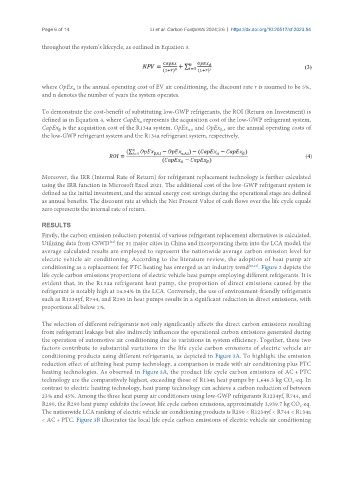
               throughout the system’s lifecycle, as outlined in Equation 3.


               where OpEx  is the annual operating cost of EV air conditioning, the discount rate r is assumed to be 5%,
                          A
               and n denotes the number of years the system operates.

               To demonstrate the cost-benefit of substituting low-GWP refrigerants, the ROI (Return on Investment) is
               defined as in Equation 4, where CapEx  represents the acquisition cost of the low-GWP refrigerant system,
                                                α
               CapEx  is the acquisition cost of the R134a system. OpEx  and OpEx  are the annual operating costs of
                     β
                                                                           β,A
                                                                α,A
               the low-GWP refrigerant system and the R134a refrigerant system, respectively.


               Moreover, the IRR (Internal Rate of Return) for refrigerant replacement technology is further calculated
               using the IRR function in Microsoft Excel 2021. The additional cost of the low-GWP refrigerant system is
               defined as the initial investment, and the annual energy cost savings during the operational stage are defined
               as annual benefits. The discount rate at which the Net Present Value of cash flows over the life cycle equals
               zero represents the internal rate of return.


               RESULTS
               Firstly, the carbon emission reduction potential of various refrigerant replacement alternatives is calculated.
               Utilizing data from CSWD  for 31 major cities in China and incorporating them into the LCA model, the
                                      [24]
               average calculated results are employed to represent the nationwide average carbon emission level for
               electric vehicle air conditioning. According to the literature review, the adoption of heat pump air
               conditioning as a replacement for PTC heating has emerged as an industry trend [20,21] . Figure 2 depicts the
               life cycle carbon emissions proportions of electric vehicle heat pumps employing different refrigerants. It is
               evident that, in the R134a refrigerant heat pump, the proportion of direct emissions caused by the
               refrigerant is notably high at 24.54% in the LCA. Conversely, the use of environment-friendly refrigerants
               such as R1234yf, R744, and R290 in heat pumps results in a significant reduction in direct emissions, with
               proportions all below 1%.

               The selection of different refrigerants not only significantly affects the direct carbon emissions resulting
               from refrigerant leakage but also indirectly influences the operational carbon emissions generated during
               the operation of automotive air conditioning due to variations in system efficiency. Together, these two
               factors contribute to substantial variations in the life cycle carbon emissions of electric vehicle air
               conditioning products using different refrigerants, as depicted in Figure 3A. To highlight the emission
               reduction effect of utilizing heat pump technology, a comparison is made with air conditioning plus PTC
               heating technologies. As observed in Figure 3A, the product life cycle carbon emissions of AC + PTC
               technology are the comparatively highest, exceeding those of R134a heat pumps by 1,646.3 kg CO -eq. In
                                                                                                    2
               contrast to electric heating technology, heat pump technology can achieve a carbon reduction of between
               23% and 45%. Among the three heat pump air conditioners using low-GWP refrigerants R1234yf, R744, and
               R290, the R290 heat pump exhibits the lowest life cycle carbon emissions, approximately 3,939.7 kg CO -eq.
                                                                                                      2
               The nationwide LCA ranking of electric vehicle air conditioning products is R290 < R1234yf < R744 < R134a
               < AC + PTC. Figure 3B illustrates the local life cycle carbon emissions of electric vehicle air conditioning

