


Page 14 - Read Online
P. 14
Page 10 of 14                        Li et al. Carbon Footprints 2024;3:6  https://dx.doi.org/10.20517/cf.2023.54


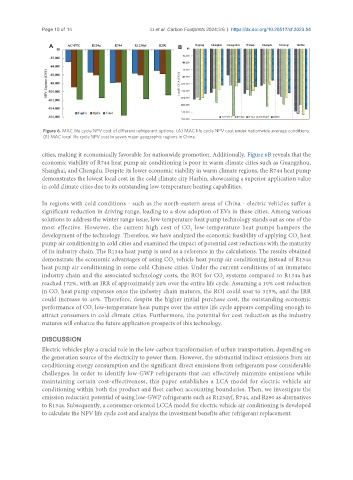
                Figure 6. MAC life cycle NPV cost of different refrigerant options. (A) MAC life cycle NPV cost under nationwide average conditions.
                (B) MAC local life cycle NPV cost in seven major geographic regions in China.


               cities, making it economically favorable for nationwide promotion. Additionally, Figure 6B reveals that the
               economic viability of R744 heat pump air conditioning is poor in warm climate cities such as Guangzhou,
               Shanghai, and Chengdu. Despite its lower economic viability in warm climate regions, the R744 heat pump
               demonstrates the lowest local cost in the cold climate city Harbin, showcasing a superior application value
               in cold climate cities due to its outstanding low-temperature heating capabilities.


               In regions with cold conditions - such as the north-eastern areas of China - electric vehicles suffer a
               significant reduction in driving range, leading to a slow adoption of EVs in these cities. Among various
               solutions to address the winter range issue, low-temperature heat pump technology stands out as one of the
               most effective. However, the current high cost of CO  low-temperature heat pumps hampers the
                                                                 2
               development of the technology. Therefore, we have analyzed the economic feasibility of applying CO  heat
                                                                                                     2
               pump air conditioning in cold cities and examined the impact of potential cost reductions with the maturity
               of its industry chain. The R134a heat pump is used as a reference in the calculations. The results obtained
               demonstrate the economic advantages of using CO  vehicle heat pump air conditioning instead of R134a
                                                           2
               heat pump air conditioning in some cold Chinese cities. Under the current conditions of an immature
               industry chain and the associated technology costs, the ROI for CO  systems compared to R134a has
                                                                            2
               reached 172%, with an IRR of approximately 24% over the entire life cycle. Assuming a 10% cost reduction
               in CO  heat pump expenses once the industry chain matures, the ROI could soar to 315%, and the IRR
                     2
               could increase to 40%. Therefore, despite the higher initial purchase cost, the outstanding economic
               performance of CO  low-temperature heat pumps over the entire life cycle appears compelling enough to
                                2
               attract consumers in cold climate cities. Furthermore, the potential for cost reduction as the industry
               matures will enhance the future application prospects of this technology.


               DISCUSSION
               Electric vehicles play a crucial role in the low-carbon transformation of urban transportation, depending on
               the generation source of the electricity to power them. However, the substantial indirect emissions from air
               conditioning energy consumption and the significant direct emissions from refrigerants pose considerable
               challenges. In order to identify low-GWP refrigerants that can effectively minimize emissions while
               maintaining certain cost-effectiveness, this paper establishes a LCA model for electric vehicle air
               conditioning within both the product and fleet carbon accounting boundaries. Then, we investigate the
               emission reduction potential of using low-GWP refrigerants such as R1234yf, R744, and R290 as alternatives
               to R134a. Subsequently, a consumer-oriented LCCA model for electric vehicle air conditioning is developed
               to calculate the NPV life cycle cost and analyze the investment benefits after refrigerant replacement.

