


Page 45 - Read Online
P. 45
Page 10 of 13                   Cheng et al. Carbon Footprints 2024;3:10  https://dx.doi.org/10.20517/cf.2023.53


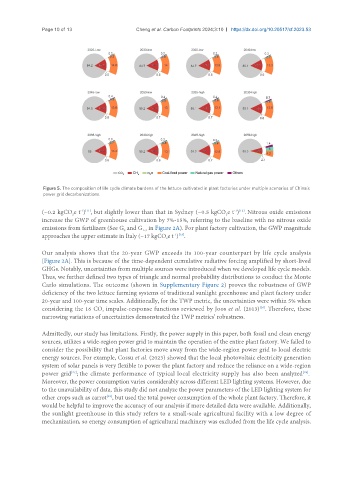
                Figure 5. The composition of life cycle climate burdens of the lettuce cultivated in plant factories under multiple scenarios of China’s
                power grid decarbonizations.


               (~0.2 kgCO e t ) , but slightly lower than that in Sydney (~0.5 kgCO e t ) . Nitrous oxide emissions
                            -1 [11]
                                                                                -1 [12]
                         2
                                                                             2
               increase the GWP of greenhouse cultivation by 7%-15%, referring to the baseline with no nitrous oxide
               emissions from fertilizers (See G  and G  in Figure 2A). For plant factory cultivation, the GWP magnitude
                                                 1-3
                                           0
                                                            -1 [13]
               approaches the upper estimate in Italy (~17 kgCO e t ) .
                                                         2
               Our analysis shows that the 20-year GWP exceeds its 100-year counterpart by life cycle analysis
               [Figure 2A]. This is because of the time-dependent cumulative radiative forcing amplified by short-lived
               GHGs. Notably, uncertainties from multiple sources were introduced when we developed life cycle models.
               Thus, we further defined two types of triangle and normal probability distributions to conduct the Monte
               Carlo simulations. The outcome (shown in Supplementary Figure 2) proves the robustness of GWP
               deficiency of the two lettuce farming systems of traditional sunlight greenhouse and plant factory under
               20-year and 100-year time scales. Additionally, for the TWP metric, the uncertainties were within 5% when
               considering the 16 CO  impulse-response functions reviewed by Joos et al. (2013) . Therefore, these
                                                                                         [26]
                                   2
               narrowing variations of uncertainties demonstrated the TWP metrics’ robustness.
               Admittedly, our study has limitations. Firstly, the power supply in this paper, both fossil and clean energy
               sources, utilizes a wide-region power grid to maintain the operation of the entire plant factory. We failed to
               consider the possibility that plant factories move away from the wide-region power grid to local electric
               energy sources. For example, Cossu et al. (2023) showed that the local photovoltaic electricity generation
               system of solar panels is very flexible to power the plant factory and reduce the reliance on a wide-region
               power grid ; the climate performance of typical local electricity supply has also been analyzed .
                         [27]
                                                                                                       [28]
               Moreover, the power consumption varies considerably across different LED lighting systems. However, due
               to the unavailability of data, this study did not analyze the power parameters of the LED lighting system for
               other crops such as carrot , but used the total power consumption of the whole plant factory. Therefore, it
                                     [29]
               would be helpful to improve the accuracy of our analysis if more detailed data were available. Additionally,
               the sunlight greenhouse in this study refers to a small-scale agricultural facility with a low degree of
               mechanization, so energy consumption of agricultural machinery was excluded from the life cycle analysis.

