


Page 41 - Read Online
P. 41
Page 6 of 13                    Cheng et al. Carbon Footprints 2024;3:10  https://dx.doi.org/10.20517/cf.2023.53


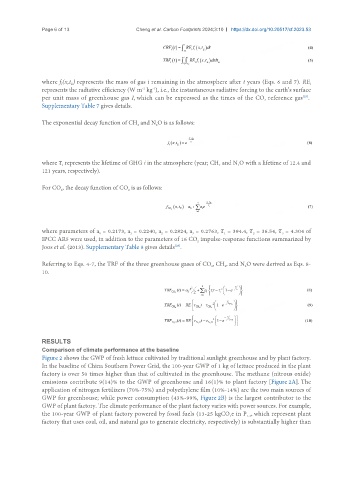
               where f (x,t ) represents the mass of gas i remaining in the atmosphere after t years (Eqs. 6 and 7). RE   i
                      i
                         E
                                                    -1
                                                 -2
               represents the radiative efficiency (W m  kg ), i.e., the instantaneous radiative forcing to the earth’s surface
               per unit mass of greenhouse gas I, which can be expressed as the times of the CO  reference gas .
                                                                                                       [25]
                                                                                          2
               Supplementary Table 7 gives details.
               The exponential decay function of CH  and N O is as follows:
                                               4
                                                      2


               where    represents the lifetime of GHG i in the atmosphere (year; CH  and N O with a lifetime of 12.4 and
                      i
                                                                                 2
                                                                           4
               121 years, respectively).
               For CO , the decay function of CO  is as follows:
                                            2
                      2


               where parameters of a  = 0.2173, a  = 0.2240, a  = 0.2824, a  = 0.2763,     = 394.4,     = 36.54,     = 4.304 of
                                                                  3
                                  0
                                             1
                                                                                      2
                                                                                                3
                                                       2
                                                                             1
               IPCC AR5 were used, in addition to the parameters of 16 CO  impulse-response functions summarized by
                                                                    2
               Joos et al. (2013). Supplementary Table 8 gives details .
                                                            [26]
               Referring to Eqs. 4-7, the TRF of the three greenhouse gases of CO , CH , and N O were derived as Eqs. 8-
                                                                        2
                                                                             4
                                                                                    2
               10.


               RESULTS
               Comparison of climate performance at the baseline
               Figure 2 shows the GWP of fresh lettuce cultivated by traditional sunlight greenhouse and by plant factory.
               In the baseline of China Southern Power Grid, the 100-year GWP of 1 kg of lettuce produced in the plant
               factory is over 50 times higher than that of cultivated in the greenhouse. The methane (nitrous oxide)
               emissions contribute 9(14)% to the GWP of greenhouse and 16(1)% to plant factory [Figure 2A]. The
               application of nitrogen fertilizers (70%-75%) and polyethylene film (10%-14%) are the two main sources of
               GWP for greenhouse; while power consumption (43%-99%, Figure 2B) is the largest contributor to the
               GWP of plant factory. The climate performance of the plant factory varies with power sources. For example,
               the 100-year GWP of plant factory powered by fossil fuels (13-25 kgCO e in P , which represent plant
                                                                              2
                                                                                    1-3
               factory that uses coal, oil, and natural gas to generate electricity, respectively) is substantially higher than

