


Page 44 - Read Online
P. 44
Singh et al. Cancer Drug Resist. 2025;8:56                                        Page 9 of 20


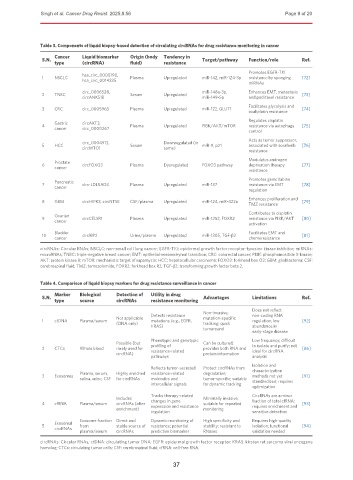
               Table 3. Components of liquid biopsy-based detection of circulating circRNAs for drug resistance monitoring in cancer
                   Cancer    Liquid biomarker  Origin (body  Tendency in
               S.N.                                                  Target/pathway  Function/role     Ref.
                   type      (circRNA)       fluid)     resistance
                                                                                     Promotes EGFR-TKI
                             hsa_circ_0000190,
               1   NSCLC                     Plasma     Upregulated  miR-142, miR-124-3p  resistance by sponging  [72]
                             hsa_circ_0014235
                                                                                     miRNAs
                             circ_0006528,                           miR-148a-3p,    Enhances EMT, metastasis
               2   TNBC                      Serum      Upregulated                                    [73]
                             circANKS1B                              miR-149-5p      and paclitaxel resistance
                                                                                     Facilitates glycolysis and
               3   CRC       circ_0005963    Plasma     Upregulated  miR-122, GLUT1                    [74]
                                                                                     oxaliplatin resistance
                                                                                     Regulates cisplatin
                   Gastric   circAKT3,
               4                             Plasma     Upregulated  PI3K/AKT/mTOR   resistance via autophagy  [75]
                   cancer    circ_0000267
                                                                                     control
                                                                                     Acts as tumor suppressor;
                             circ_0004913,              Downregulated (in
               5   HCC                       Serum                   miR-9, p21      associated with sorafenib  [76]
                             circMTO1                   some)
                                                                                     resistance
                                                                                     Modulates androgen
                   Prostate
               6             circFOXO3       Plasma     Dysregulated  FOXO3 pathway  deprivation therapy  [77]
                   cancer
                                                                                     resistance
                                                                                     Promotes gemcitabine
                   Pancreatic
               7             circ-LDLRAD3    Plasma     Upregulated  miR-137         resistance via EMT  [78]
                   cancer
                                                                                     regulation
                                                                                     Enhances proliferation and
               8   GBM       circHIPK3, circNT5E  CSF/plasma  Upregulated  miR-124, miR-422a           [79]
                                                                                     TMZ resistance
                                                                                     Contributes to cisplatin
                   Ovarian
               9             circCELSR1      Plasma     Upregulated  miR-1252, FOXR2  resistance via PI3K/AKT  [80]
                   cancer
                                                                                     activation
                   Bladder                                                           Facilitates EMT and
               10            circRIP2        Urine/plasma  Upregulated  miR-1305, TGF-β2               [81]
                   cancer                                                            chemoresistance
               circRNAs: Circular RNAs; NSCLC: non-small cell lung cancer; EGFR-TKI: epidermal growth factor receptor-tyrosine kinase inhibitor; miRNAs:
               microRNAs; TNBC: triple-negative breast cancer; EMT: epithelial-mesenchymal transition; CRC: colorectal cancer; PI3K: phosphoinositide 3-kinase;
               AKT: protein kinase B; mTOR: mechanistic target of rapamycin; HCC: hepatocellular carcinoma; FOXO3: forkhead box O3; GBM: glioblastoma; CSF:
               cerebrospinal fluid; TMZ: temozolomide; FOXR2: forkhead box R2; TGF-β2: transforming growth factor beta 2.
               Table 4. Comparison of liquid biopsy markers for drug resistance surveillance in cancer
                   Marker   Biological  Detection of  Utility in drug
               S.N.                                                   Advantages      Limitations      Ref.
                   type     source      circRNAs    resistance monitoring
                                                                                      Does not reflect
                                                                      Non-invasive;
                                                    Detects resistance                non-coding RNA
                                        Not applicable                mutation-specific
               1   ctDNA    Plasma/serum            mutations (e.g., EGFR,            regulation; low  [92]
                                        (DNA only)                    tracking; quick
                                                    KRAS)                             abundance in
                                                                      turnaround
                                                                                      early-stage disease
                                                    Phenotypic and genotypic          Low frequency; difficult
                                        Possible (but  profiling of   Can be cultured;  to isolate and purify; not
               2   CTCs     Whole blood  rarely used for  resistance-related  provides both RNA and  ideal for circRNA  [86]
                                        circRNA)                      protein information
                                                    pathways                          analysis
                                                                                      Isolation and
                                                    Reflects tumor-secreted  Protect circRNAs from  characterization
                            Plasma, serum,  Highly enriched  resistance-related  degradation;
               3   Exosomes                                                           methods not yet  [91]
                            saliva, urine, CSF  for circRNAs  molecules and  tumor-specific; suitable  standardized; requires
                                                    intercellular signals  for dynamic tracking
                                                                                      optimization
                                                    Tracks therapy-related            CircRNAs are a minor
                                        Includes    changes in gene   Minimally invasive;  fraction of total cfRNA;
               4   cfRNA    Plasma/serum  circRNAs (after  expression and resistance  suitable for repeated  requires enrichment and  [93]
                                        enrichment)                   monitoring
                                                    regulation                        sensitive detection
                            Exosome fraction  Direct and  Dynamic monitoring of  High specificity and  Requires high-quality
                   Exosomal
               5            from        stable source of  resistance; potential  stability; resistant to  isolation; functional  [94]
                   circRNAs
                            plasma/serum  circRNAs  predictive biomarker  RNases      validation needed
               circRNAs: Circular RNAs; ctDNA: circulating tumor DNA; EGFR: epidermal growth factor receptor; KRAS: kirsten rat sarcoma viral oncogene
               homolog; CTCs: circulating tumor cells; CSF: cerebrospinal fluid; cfRNA: cell-free RNA.
                                                           37

