


Page 41 - Read Online
P. 41
Page 6 of 20                                                 Singh et al. Cancer Drug Resist. 2025;8:56


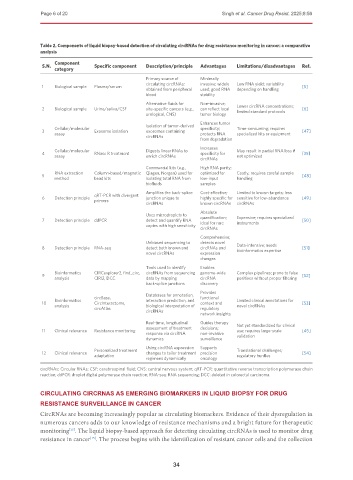
               Table 2. Components of liquid biopsy-based detection of circulating circRNAs for drug resistance monitoring in cancer: a comparative
               analysis

                   Component
               S.N.              Specific component  Description/principle  Advantages  Limitations/disadvantages  Ref.
                   category
                                                  Primary source of  Minimally
                                                  circulating circRNAs;  invasive; widely  Low RNA yield; variability
               1   Biological sample  Plasma/serum                                                     [5]
                                                  obtained from peripheral  used; good RNA  depending on handling
                                                  blood              stability
                                                  Alternative fluids for  Non-invasive;  Lower circRNA concentrations;
               2   Biological sample  Urine/saliva/CSF  site-specific cancers (e.g.,  can reflect local  limited standard protocols  [6]
                                                  urological, CNS)   tumor biology
                                                                     Enhances tumor
                                                  Isolation of tumor-derived
                   Cellular/molecular                                specificity;  Time-consuming; requires
               3                 Exosome isolation  exosomes containing                                [47]
                   assay                                             protects RNA  specialized kits or equipment
                                                  circRNAs
                                                                     from degradation
                                                                     Increases
                   Cellular/molecular             Digests linear RNAs to         May result in partial RNA loss if
               4                 RNase R treatment                   specificity for                   [35]
                   assay                          enrich circRNAs                not optimized
                                                                     circRNAs
                                                  Commercial kits (e.g.,  High RNA purity;
                   RNA extraction  Column-based/magnetic  Qiagen, Norgen) used for  optimized for  Costly; requires careful sample
               5                                                                                       [48]
                   method        bead kits        isolating total RNA from  low-input  handling
                                                  biofluids          samples
                                                  Amplifies the back-splice  Cost-effective;  Limited to known targets; less
                                 qRT-PCR with divergent
               6   Detection principle            junction unique to  highly specific for sensitive for low-abundance  [49]
                                 primers
                                                  circRNAs           known circRNAs  circRNAs
                                                                     Absolute
                                                  Uses microdroplets to
               7   Detection principle  ddPCR     detect and quantify RNA  quantification;  Expensive; requires specialized  [50]
                                                  copies with high sensitivity  ideal for rare  instruments
                                                                     circRNAs
                                                                     Comprehensive;
                                                  Unbiased sequencing to  detects novel  Data-intensive; needs
               8   Detection principle  RNA-seq   detect both known and  circRNAs and  bioinformatics expertise  [51]
                                                  novel circRNAs     expression
                                                                     changes
                                                  Tools used to identify  Enables
                   Bioinformatics  CIRCexplorer2, find_circ,  circRNAs from sequencing  genome-wide  Complex pipelines; prone to false
               9                                                                                       [52]
                   analysis      CIRI2, DCC       data by mapping    circRNA     positives without proper filtering
                                                  back-splice junctions  discovery
                                                                     Provides
                                                  Databases for annotation,
                                 circBase,                           functional
                   Bioinformatics                 interaction prediction, and    Limited clinical annotations for
               10                CircInteractome,                    context and                       [53]
                   analysis                       biological interpretation of   novel circRNAs
                                 circAtlas                           regulatory
                                                  circRNAs
                                                                     network insights
                                                  Real-time, longitudinal  Guides therapy  Not yet standardized for clinical
                                                  assessment of treatment  decisions;
               11  Clinical relevance  Resistance monitoring                     use; requires large-scale  [45]
                                                  response via circRNA  non-invasive  validation
                                                  dynamics           surveillance
                                                  Using circRNA expression  Supports
                                 Personalized treatment                          Translational challenges;
               12  Clinical relevance             changes to tailor treatment precision                [54]
                                 adaptation                                      regulatory hurdles
                                                  regimens dynamically  oncology
               circRNAs: Circular RNAs; CSF: cerebrospinal fluid; CNS: central nervous system; qRT-PCR: quantitative reverse transcription polymerase chain
               reaction; ddPCR: droplet digital polymerase chain reaction; RNA-seq: RNA sequencing; DCC: deleted in colorectal carcinoma.
               CIRCULATING CIRCRNAS AS EMERGING BIOMARKERS IN LIQUID BIOPSY FOR DRUG
               RESISTANCE SURVEILLANCE IN CANCER
               CircRNAs are becoming increasingly popular as circulating biomarkers. Evidence of their dysregulation in
               numerous cancers adds to our knowledge of resistance mechanisms and a bright future for therapeutic
               monitoring . The liquid biopsy-based approach for detecting circulating circRNAs is used to monitor drug
                        [15]
               resistance in cancer . The process begins with the identification of resistant cancer cells and the collection
                               [15]


                                                           34

