


Page 140 - Read Online
P. 140
Wang et al. Cancer Drug Resist. 2026;9:8                                          Page 7 of 18


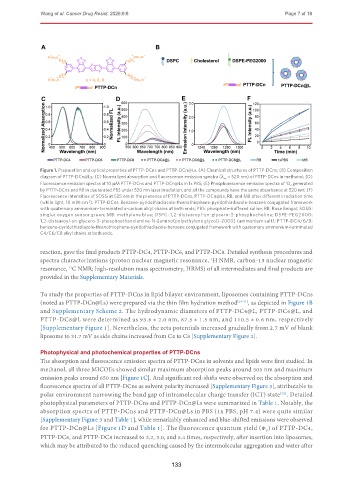
               Figure 1. Preparation and optical properties of PTTP-DCns and PTTP-DCn@Ls. (A) Chemical structures of PTTP-DCns; (B) Composition
               diagram of PTTP-DCn@Ls; (C) Normalized absorption and fluorescence emission spectra (λ ex  = 520 nm) of PTTP-DCns in methanol; (D)
               Fluorescence emission spectra of 10 µM PTTP-DCns and PTTP-DCn@Ls in 1x PBS; (E) Phosphorescence emission spectra of  O 2  generated
                                                                                                 1
               by PTTP-DCns and RB in deuterated PBS under 520 nm laser irradiation, and all the compounds have the same absorbance at 520 nm; (F)
               Fluorescence intensities of SOSG at 525 nm in the presence of PTTP-DCns, PTTP-DCn@Ls, RB, and MB after different irradiation time
               (white light, 10 mW·cm ). PTTP-DCns: Benzene-pyridothiadiazole-thienothiophene-pyridothiadiazole-benzene conjugated framework
                               -2
               with quaternary ammonium-terminated n-carbon alkyl chains at both ends; PBS: phosphate-buffered saline; RB: Rose Bengal; SOSG:
               singlet oxygen sensor green; MB: methylene blue; DSPC: 1,2-distearoyl-sn-glycero-3-phosphocholine; DSPE-PEG2000:
               1,2-distearoyl-sn-glycero-3-phosphoethanolamine-N-[amino(polyethylene glycol)-2000] (ammonium salt); PTTP-DC4/6/8:
               benzene-pyridothiadiazole-thienothiophene-pyridothiadiazole-benzene conjugated framework with quaternary ammonium-terminated
               C4/C6/C8 alkyl chains at both ends.

               reaction, gave the final products PTTP-DC4, PTTP-DC6, and PTTP-DC8. Detailed synthesis procedures and
               spectra characterizations (proton nuclear magnetic resonance,  H NMR, carbon-13 nuclear magnetic
                                                                        1
               resonance,  C NMR; high-resolution mass spectrometry, HRMS) of all intermediates and final products are
                        13
               provided in the Supplementary Materials.

               To study the properties of PTTP-DCns in lipid bilayer environment, liposomes containing PTTP-DCns
               (noted as PTTP-DCn@Ls) were prepared via the thin film hydration method [29-31] , as depicted in Figure 1B
               and Supplementary Scheme 2. The hydrodynamic diameters of PTTP-DC4@L, PTTP-DC6@L, and
               PTTP-DC8@L were determined as 93.6 ± 2.0 nm, 87.5 ± 1.5 nm, and 110.5 ± 0.6 nm, respectively
               [Supplementary Figure 1]. Nevertheless, the zeta potentials increased gradually from 2.7 mV of blank
               liposome to 31.7 mV as side chains increased from C4 to C8 [Supplementary Figure 2].


               Photophysical and photochemical properties of PTTP-DCns
               The absorption and fluorescence emission spectra of PTTP-DCns in solvents and lipids were first studied. In
               methanol, all three MICOEs showed similar maximum absorption peaks around 505 nm and maximum
               emission peaks around 650 nm [Figure 1C]. And significant red-shifts were observed on the absorption and
               fluorescence spectra of all PTTP-DCns as solvent polarity increased [Supplementary Figure 3], attributable to
               polar environment narrowing the band gap of intramolecular charge transfer (ICT) state . Detailed
                                                                                               [32]
               photophysical parameters of PTTP-DCns and PTTP-DCn@Ls were summarized in Table 1. Notably, the
               absorption spectra of PTTP-DCns and PTTP-DCn@Ls in PBS (1x PBS, pH 7.4) were quite similar
               [Supplementary Figure 3 and Table 1], while remarkably enhanced and blue-shifted emissions were observed
               for PTTP-DCn@Ls [Figure 1D and Table 1]. The fluorescence quantum yield (Φ ) of PTTP-DC4,
                                                                                           F
               PTTP-DC6, and PTTP-DC8 increased to 2.2, 3.0, and 5.4 times, respectively, after insertion into liposomes,
               which may be attributed to the reduced quenching caused by the intermolecular aggregation and water after


                                                           133

