


Page 137 - Read Online
P. 137
Page 4 of 18                                                  Wang et al. Cancer Drug Resist. 2026;9:8


               irradiated under white light (equipped with a UV cut filter, 10 mW·cm ) for 10 min, and fluorescence
                                                                              -2
               emission at 525 nm was monitored, with an excitation wavelength (λ ) of 488 nm.
                                                                        ex
               For the quantitative determination of singlet oxygen quantum yield (Φ ) via  O  phosphorescence detection,
                                                                                1
                                                                          Δ
                                                                                  2
               PTTP-DCns and RB were dissolved in deuterated PBS and adjusted to the same absorbance at 520 nm (A =
               0.7). The solutions were degassed by nitrogen bubbling for 10 min. The near-infrared emission between
               1,200-1,400 nm was collected. A fourth-order polynomial fitting method was used to fit the data of degassed
               PTTP-DCns from 1,200-1,230 nm and 1,310-1,370 nm. The fitting curve was used to simulate the emission
               spectrum of PTTP-DCns as background to get the  O  phosphorescence spectrum in PTTP-DCns solution.
                                                          1
                                                            2
               Then, the  O  phosphorescence spectra were fitted by a GaussAmp fitting method in the origin software. The
                       1
                         2
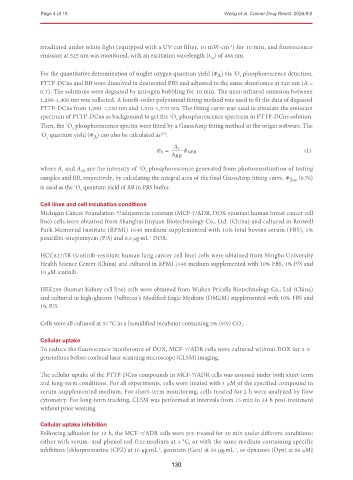
               1 O  quantum yield (Φ ) can also be calculated as :
                                                       [27]
                                 Δ
                 2

                                                      Φ Δ =    Φ Δ                                      (1)

               where A  and A  are the intensity of  O  phosphorescence generated from photosensitization of testing
                                                1
                      s
                            RB
                                                  2
               samples and RB, respectively, by calculating the integral area of the final GaussAmp fitting curve. Φ  (0.76)
                                                                                                   ΔRB
               is used as the  O  quantum yield of RB in PBS buffer.
                          1
                            2
               Cell lines and cell incubation conditions
               Michigan Cancer Foundation-7/adriamycin-resistant (MCF-7/ADR, DOX-resistant human breast cancer cell
               line) cells were obtained from Shanghai Jinyuan Biotechnology Co., Ltd. (China) and cultured in Roswell
               Park Memorial Institute (RPMI) 1640 medium supplemented with 10% fetal bovine serum (FBS), 1%
               penicillin-streptomycin (P/S) and 0.5 μg·mL  DOX.
                                                   -1
               HCC827/IR (icotinib-resistant human lung cancer cell line) cells were obtained from Ningbo University
               Health Science Center (China) and cultured in RPMI 1640 medium supplemented with 10% FBS, 1% P/S and
               10 μM icotinib.


               HEK293 (human kidney cell line) cells were obtained from Wuhan Pricella Biotechnology Co., Ltd (China)
               and cultured in high-glucose Dulbecco’s Modified Eagle Medium (DMEM) supplemented with 10% FBS and
               1% P/S.


               Cells were all cultured at 37 °C in a humidified incubator containing 5% (v/v) CO .
                                                                                  2

               Cellular uptake
               To reduce the fluorescence interference of DOX, MCF-7/ADR cells were cultured without DOX for 2-3
               generations before confocal laser scanning microscope (CLSM) imaging.


               The cellular uptake of the PTTP-DCns compounds in MCF-7/ADR cells was assessed under both short-term
               and long-term conditions. For all experiments, cells were treated with 1 µM of the specified compound in
               serum-supplemented medium. For short-term monitoring, cells treated for 2 h were analyzed by flow
               cytometry. For long-term tracking, CLSM was performed at intervals from 15 min to 24 h post-treatment
               without prior washing.


               Cellular uptake inhibition
               Following adhesion for 12 h, the MCF-7/ADR cells were pre-treated for 30 min under different conditions:
               either with serum- and phenol red-free medium at 4 °C, or with the same medium containing specific
               inhibitors [chlorpromazine (CPZ) at 10 µg·mL , genistein (Gen) at 50 µg·mL , or dynasore (Dyn) at 80 µM]
                                                      -1
                                                                                -1
                                                           130

