


Page 56 - Read Online
P. 56
Page 459                        Goyal et al. Art Int Surg. 2025;5:450-64  https://dx.doi.org/10.20517/ais.2024.108

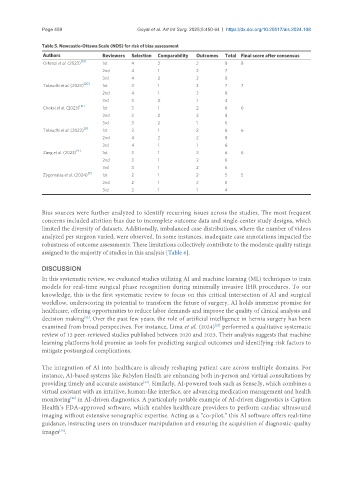
               Table 5. Newcastle-Ottawa Scale (NOS) for risk of bias assessment
               Authors              Reviewers  Selection  Comparability  Outcomes  Total Final score after consensus
                Ortenzi et al. (2023) [10]  1st  4    2            2         8    8
                                    2nd      4        1            2         7
                                    3rd      4        2            2         8
                             [20]
                Takeuchi et al. (2023)  1st  3        1            3         7    7
                                    2nd      4        1            3         8
                                    3rd      3        0            1         4
                            [21]
                Choksi et al. (2023)  1st    3        1            2         6    6
                                    2nd      3        2            3         8
                                    3rd      3        2            1         6
                Takeuchi et al. (2022) [8]  1st  3    1            2         6    6
                                    2nd      4        2            2         8
                                    3rd      4        1            1         6
                           [9]
                Zang et al. (2023)  1st      3        1            2         6    6
                                    2nd      3        1            2         6
                                    3rd      3        1            2         6
                               [7]
                Zygomalas et al. (2024)  1st  2       1            2         5    5
                                    2nd      2        1            2         5
                                    3rd      2        1            1         4


               Bias sources were further analyzed to identify recurring issues across the studies. The most frequent
               concerns included attrition bias due to incomplete outcome data and single-center study designs, which
               limited the diversity of datasets. Additionally, imbalanced case distributions, where the number of videos
               analyzed per surgeon varied, were observed. In some instances, inadequate case annotations impacted the
               robustness of outcome assessments. These limitations collectively contribute to the moderate quality ratings
               assigned to the majority of studies in this analysis [Table 6].


               DISCUSSION
               In this systematic review, we evaluated studies utilizing AI and machine learning (ML) techniques to train
               models for real-time surgical phase recognition during minimally invasive IHR procedures. To our
               knowledge, this is the first systematic review to focus on this critical intersection of AI and surgical
               workflow, underscoring its potential to transform the future of surgery. AI holds immense promise for
               healthcare, offering opportunities to reduce labor demands and improve the quality of clinical analysis and
               decision making . Over the past few years, the role of artificial intelligence in hernia surgery has been
                             [22]
               examined from broad perspectives. For instance, Lima et al. (2024)  performed a qualitative systematic
                                                                         [23]
               review of 13 peer-reviewed studies published between 2020 and 2023. Their analysis suggests that machine
               learning platforms hold promise as tools for predicting surgical outcomes and identifying risk factors to
               mitigate postsurgical complications.

               The integration of AI into healthcare is already reshaping patient care across multiple domains. For
               instance, AI-based systems like Babylon Health are enhancing both in-person and virtual consultations by
               providing timely and accurate assistance . Similarly, AI-powered tools such as Sense.ly, which combines a
                                                 [24]
               virtual assistant with an intuitive, human-like interface, are advancing medication management and health
                         [25]
               monitoring  in AI-driven diagnostics. A particularly notable example of AI-driven diagnostics is Caption
               Health’s FDA-approved software, which enables healthcare providers to perform cardiac ultrasound
               imaging without extensive sonographic expertise. Acting as a “co-pilot,” this AI software offers real-time
               guidance, instructing users on transducer manipulation and ensuring the acquisition of diagnostic-quality
               images .
                     [26]

