


Page 53 - Read Online
P. 53
Page 457                                                                                                 Goyal et al. Art Int Surg. 2025;5:450-64   https://dx.doi.org/10.20517/ais.2024.108


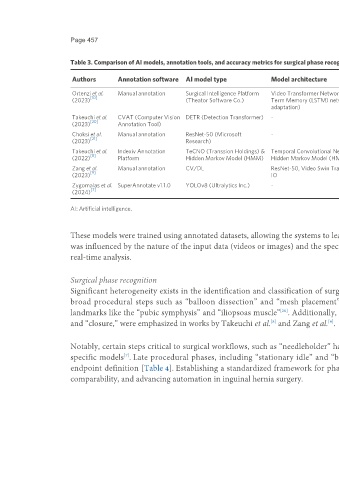
                          Table 3. Comparison of AI models, annotation tools, and accuracy metrics for surgical phase recognition

                                                                                                                                            Number of                                               F1
                          Authors         Annotation software     AI model type                 Model architecture                                         Overall accuracy                                 Precision
                                                                                                                                            surgeons                                                score
                          Ortenzi et al.   Manual annotation      Surgical Intelligence Platform   Video Transformer Network (VTN), Long Short- 85         88.8% (89.16% with an overall 89.59% for  -      -
                                 [10]
                          (2023)                                  (Theator Software Co.)        Term Memory (LSTM) network (for model                      unilateral; 83.17% with an overall 88.45%
                                                                                                adaptation)                                                for bilateral)
                          Takeuchi et al.   CVAT (Computer Vision  DETR (Detection Transformer)  -                                          11             77.10%                                   75.40% 51.20%
                                 [20]
                          (2023)          Annotation Tool)
                          Choksi et al.   Manual annotation       ResNet-50 (Microsoft          -                                           8              68.7% (59.8% - 78.2%)                    -       -
                                 [21]
                          (2023)                                  Research)
                          Takeuchi et al.   Indexiv Annotation    TeCNO (Transsion Holdings) &  Temporal Convolutional Network (MS-TCN) +   11             Unilateral: 88.81%; Bilateral: 85.82%    -       -
                                 [8]
                          (2022)          Platform                Hidden Markov Model (HMM)     Hidden Markov Model (HMM)
                          Zang et al.     Manual annotation       CV/DL                         ResNet-50, Video Swin Transformer, Perceiver   8           85%                                      75.81%  -
                                 [9]
                          (2023)                                                                IO
                          Zygomalas et al.  SuperAnnotate v1.1.0  YOLOv8 (Ultralytics Inc.)     -                                           5              87.30%                                   82%     > 50%
                                 [7]
                          (2024)

                          AI: Artificial intelligence.


                          These models were trained using annotated datasets, allowing the systems to learn and identify specific structures accurately. The choice of model architecture

                          was influenced by the nature of the input data (videos or images) and the specific requirements of the task, such as temporal modeling, feature extraction, or
                          real-time analysis.


                          Surgical phase recognition

                          Significant heterogeneity exists in the identification and classification of surgical phases during IHR across included studies. While some studies focus on
                          broad procedural steps such as “balloon dissection” and “mesh placement” , others incorporate a more granular breakdown, identifying anatomical
                                                                                                                        [10]
                          landmarks like the “pubic symphysis” and “iliopsoas muscle” . Additionally, phases related to peritoneal manipulation, including “peritoneal flap incision”
                                                                                                   [20]
                          and “closure,” were emphasized in works by Takeuchi et al.  and Zang et al. .
                                                                                                                    [9]
                                                                                                [8]

                          Notably, certain steps critical to surgical workflows, such as “needleholder” handling and recognition of vascular or ligamentous structures, were unique to
                          specific models . Late procedural phases, including “stationary idle” and “blurry” recognition, were inconsistently reported, underscoring variability in
                                            [7]
                          endpoint definition [Table 4]. Establishing a standardized framework for phase segmentation remains critical to improving model performance, ensuring
                          comparability, and advancing automation in inguinal hernia surgery.

