


Page 51 - Read Online
P. 51
Page 455                        Goyal et al. Art Int Surg. 2025;5:450-64  https://dx.doi.org/10.20517/ais.2024.108

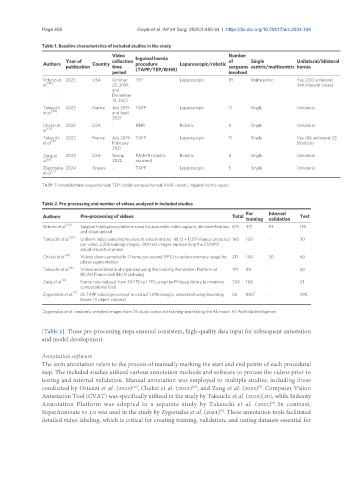
               Table 1. Baseline characteristics of included studies in the study
                                       Video   Inguinal hernia                Number
                Authors  Year of   Country  collection   procedure   Laparoscopic/robotic  of   Single   Unilateral/bilateral
                                                                              surgeons  centric/multicentric hernia
                                       time
                       publication
                                       period  (TAPP/TEP/RIHR)                involved
                Ortenzi et  2023  USA  October   TEP          Laparoscopic    85      Multicentric   Yes (270 unilateral;
                al. [10]               25, 2019,                                                     349 bilateral cases)
                                       and
                                       December
                                       13, 2022
                Takeuchi   2023  France  July 2019   TAPP     Laparoscopic    11      Single         Unilateral
                  [20]
                et al.                 and April
                                       2021
                Choksi et   2023  USA  -       RIHR           Robotic         8       Single         Unilateral
                 [21]
                al.
                Takeuchi   2022  France  July 2019- TAPP      Laparoscopic    11      Single         Yes (86 unilateral; 33
                  [8]
                et al.                 February                                                      bilateral)
                                       2021
                Zang et   2023  USA    Spring   RALIHR (robotic   Robotic     8       Single         Unilateral
                al. [9]                2022    assisted)
                Zygomalas  2024  Greece  -     TAPP           Laparoscopic    5       Single         Unilateral
                et al. [7]
               TAPP: Transabdominal preperitoneal; TEP: totally extraperitoneal; RIHR: robotic inguinal hernia repair.

               Table 2. Pre-processing and number of videos analyzed in included studies
                                                                                    For     Internal
               Authors      Pre-processing of videos                           Total                  Test
                                                                                    training  validation
                       [10]
                Ortenzi et al.  Surgical Intelligence platform used for automatic video capture, de-identification,  619  371  93  155
                            and cloud upload
                        [20]
                Takeuchi et al.  Uniform video sampling to prevent selection bias; ~18.12 ± 11.59 images extracted  160  130  -  30
                            per video. 2,356 training images; 300 test images representing the CVMPO
                            visual inspection phase
                Choksi et al. [21]  Videos down-sampled to 1 frame per second (FPS) to reduce memory usage for  211  106  30  60
                            phase segmentation
                Takeuchi et al. [8]  Videos annotated and organized using the Indexity Annotation Platform at   119  89  -  30
                            IRCAD France and IHU Strasbourg
                      [9]
                Zang et al.  Frame rate reduced from 30 FPS to 1 FPS using the FFmpeg library to minimize   209  188  -  21
                            computational load
                          [7]                                                          *                 *
                Zygomalas et al.  25 TAPP videos processed to extract 1,095 images, annotated using Bounding   25  800  -  295
                            Boxes (11 object classes)
               *
                Zygomalas et al. randomly selected images from 25 study videos for training and testing the AI model. AI: Artificial intelligence.

               [Table 2]. These pre-processing steps ensured consistent, high-quality data input for subsequent annotation
               and model development.

               Annotation software
               The term annotation refers to the process of manually marking the start and end points of each procedural
               step. The included studies utilized various annotation methods and software to process the videos prior to
               testing and internal validation. Manual annotation was employed in multiple studies, including those
                                                                  [21]
                                              [10]
                                                                                        [9]
               conducted by Ortenzi et al. (2023) , Choksi et al. (2023) , and Zang et al. (2023) . Computer Vision
               Annotation Tool (CVAT) was specifically utilized in the study by Takeuchi et al. (2023)[20], while Indexity
                                                                                            [8]
               Annotation  Platform  was  adopted  in  a  separate  study  by  Takeuchi  et  al.  (2022) . In  contrast,
                                                                           [7]
               SuperAnnotate v1.1.0 was used in the study by Zygomalas et al. (2024) . These annotation tools facilitated
               detailed video labeling, which is critical for creating training, validation, and testing datasets essential for

