


Page 15 - Read Online
P. 15
Page 8 of 20  Nappi et al. Vessel Plus 2021;5:40  https://dx.doi.org/10.20517/2574-1209.2021.06


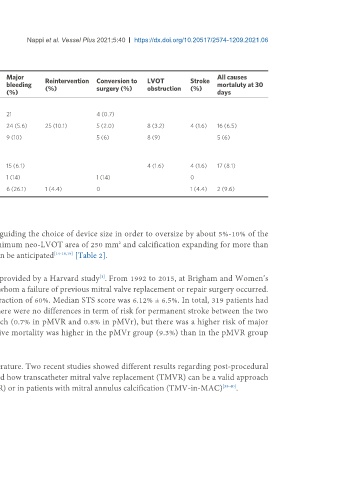
 Table 2. Operative outcomes in transcatheter approach group [1,15,23-26,31]

   Major                                                                  All causes
 Operative   Procedural   Reintervention  Conversion to   LVOT   Stroke
 Overall  bleeding                                                        mortaluty at 30
 mortality (%) success (%)  (%)   surgery (%)      obstruction   (%)
   (%)                                                                    days
 US Registry  349

 Brigham and Women’s Hospital  520  37 (7.1)  297.4 (57.2)  21  4 (0.7)
 TMVR Registry  248  3 (1.2)  212 (85.5)  24 (5.6)  25 (10.1)  5 (2.0)  8 (3.2)  4 (1.6)  16 (6.5)
 Mayo Clinic, NY University Medical Centre,   87  5 (5)  78 (90)  9 (10)  5 (6)  8 (9)  5 (6)
 Intermounitain Heart Institute, University of Alabama, St.
 Michael’s Hospital, Centre Cardiologique du Nord
 Multicentre Published reports (2009-2018)  245  14 (5.7)  229 (93.5)  15 (6.1)  4 (1.6)  4 (1.6)  17 (8.1)

 Flinders Medical Centre (Adelaide) (2017-2018)  7  1 (14)  6 (86)  1 (14)  1 (14)  0
 St. Paul’s Hospital (Vancouver, Canada)  23  0  100  6 (26.1)  1 (4.4)  0  1 (4.4)  2 (9.6)


 LVOT: Left ventricular outflow tract; TMVR: transcatheter mitral valve replacement.


 calcium deposits in the valvular annulus. The use of CT imaging is useful in guiding the choice of device size in order to oversize by about 5%-10% of the
 annulus area. In patients with oversizing superior to that 5%-10% range, a minimum neo-LVOT area of 250 mm  and calcification expanding for more than
                                         2
 270° (75%), complications such as valve embolization and LVOT obstruction can be anticipated [14-16,19]  [Table 2].


 It is important to note that a potential benchmark for the use of TMVT was provided by a Harvard study . From 1992 to 2015, at Brigham and Women’s
                                   [1]
 Hospital, the authors reported 520 potential candidates for TMViV therapy in whom a failure of previous mitral valve replacement or repair surgery occurred.
 They had a mean age of 64 ± 12 years and a median left ventricular ejection fraction of 60%. Median STS score was 6.12% ± 6.5%. In total, 319 patients had
 NYHA Class III or IV. Of all patients, 273 had pMVR and 247 had pMVr. There were no differences in term of risk for permanent stroke between the two

 groups (5.1% in pMVR and 5.3% in pMVr) or necessity of a surgical approach (0.7% in pMVR and 0.8% in pMVr), but there was a higher risk of major
 bleeding in the pMVr group (5.3%) than in the pMVR group (2.9%). Operative mortality was higher in the pMVr group (9.3%) than in the pMVR group
 (5.1%).


 Recently, this topic has been extensively investigated in the cardiovascular literature. Two recent studies showed different results regarding post-procedural
 residual mitral stenosis (MS) or residual mitral regurgitation (MR) and analyzed how transcatheter mitral valve replacement (TMVR) can be a valid approach
 to patients with prosthetic degeneration (TMViV) or ring degeneration (TMViR) or in patients with mitral annulus calcification (TMV-in-MAC) [38-40] .

