


Page 47 - Read Online
P. 47
Trahanas et al. Vessel Plus 2022;6:49  https://dx.doi.org/10.20517/2574-1209.2021.125  Page 7 of 16


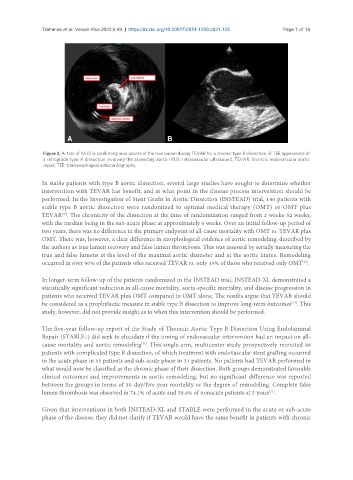
                Figure 3. A: Use of IVUS in confirming wire access of the true lumen during TEVAR for a chronic type B dissection. B: TEE appearance of
                a retrograde type A dissection involving the ascending aorta. IVUS: Intravascular ultrasound; TEVAR: thoracic endovascular aortic
                repair; TEE: transesophageal echocardiography.


               In stable patients with type B aortic dissection, several large studies have sought to determine whether
               intervention with TEVAR has benefit, and at what point in the disease process intervention should be
               performed. In the Investigation of Stent Grafts in Aortic Dissection (INSTEAD) trial, 140 patients with
               stable type B aortic dissection were randomized to optimal medical therapy (OMT) or OMT plus
               TEVAR . The chronicity of the dissection at the time of randomization ranged from 2 weeks-52 weeks,
                      [29]
               with the median being in the sub-acute phase at approximately 6 weeks. Over an initial follow-up period of
               two years, there was no difference in the primary endpoint of all-cause mortality with OMT vs. TEVAR plus
               OMT. There was, however, a clear difference in morphological evidence of aortic remodeling, described by
               the authors as true lumen recovery and false lumen thrombosis. This was assessed by serially measuring the
               true and false lumens at the level of the maximal aortic diameter and at the aortic hiatus. Remodeling
               occurred in over 90% of the patients who received TEVAR vs. only 19% of those who received only OMT .
                                                                                                       [29]

               In longer-term follow-up of the patients randomized in the INSTEAD trial, INSTEAD-XL demonstrated a
               statistically significant reduction in all-cause mortality, aorta-specific mortality, and disease progression in
               patients who received TEVAR plus OMT compared to OMT alone. The results argue that TEVAR should
               be considered as a prophylactic measure in stable type B dissection to improve long-term outcomes . This
                                                                                                   [30]
               study, however, did not provide insight as to when this intervention should be performed.

               The five-year follow-up report of the Study of Thoracic Aortic Type B Dissection Using Endoluminal
               Repair (STABLE1) did seek to elucidate if the timing of endovascular intervention had an impact on all-
               cause mortality and aortic remodeling . This single-arm, multicenter study prospectively recruited 86
                                                 [31]
               patients with complicated type B dissection, of which treatment with endovascular stent grafting occurred
               in the acute phase in 55 patients and sub-acute phase in 31 patients. No patients had TEVAR performed in
               what would now be classified as the chronic phase of their dissection. Both groups demonstrated favorable
               clinical outcomes and improvements in aortic remodeling, but no significant difference was reported
               between the groups in terms of 30-day/five-year mortality or the degree of remodeling. Complete false
               lumen thrombosis was observed in 74.1% of acute and 58.8% of nonacute patients at 5 years .
                                                                                            [31]
               Given that interventions in both INSTEAD-XL and STABLE were performed in the acute or sub-acute
               phase of the disease, they did not clarify if TEVAR would have the same benefit in patients with chronic

