


Page 128 - Read Online
P. 128
Page 10 of 15                                                       Cheng et al. Soft Sci. 2026, 6, 36


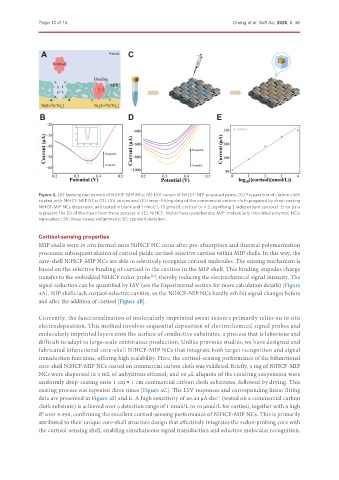
               Figure 4. (A) Sensing mechanism of NiHCF-MIP NCs; (B) LSV curves of NiHCF-NIP-prepared yarns; (C) Preparation of carbon cloth
               coated with NiHCF-MIP NCs; (D) LSV curves and (E) linear-fitting data of the commercial carbon cloth prepared by drop-casting
               NiHCF-MIP NCs dispersion, and tested in blank and 1 nmol/L~10 μmol/L cortisol (n = 3, signifying 3 independent sensors). Error bars
               represent the SD of the mean from three sensors in (E). NiHCF: Nickel hexacyanoferrate; MIP: molecularly imprinted polymer; NCs:
               nanocubes; LSV: linear sweep voltammetry; SD: standard deviation.


               Cortisol-sensing properties
               MIP shells were in situ formed onto NiHCF NC cores after pre-absorption and thermal polymerization
               processes; subsequent elution of cortisol yields cortisol-selective cavities within MIP shells. In this way, the
               core-shell NiHCF-MIP NCs are able to selectively recognize cortisol molecules. The sensing mechanism is
               based on the selective binding of cortisol to the cavities in the MIP shell. This binding impedes charge
               transfer to the embedded NiHCF redox probe , thereby reducing the electrochemical signal intensity. The
                                                      [33]
               signal reduction can be quantified by LSV (see the Experimental section for more calculation details) [Figure
               4A]. NIP shells lack cortisol-selective cavities, so the NiHCF-NIP NCs hardly exhibit signal changes before
               and after the addition of cortisol [Figure 4B].


               Currently, the functionalization of molecularly imprinted sweat sensors primarily relies on in situ
               electrodeposition. This method involves sequential deposition of electrochemical signal probes and
               molecularly imprinted layers onto the surface of conductive substrates, a process that is laborious and
               difficult to adapt to large-scale continuous production. Unlike previous studies, we have designed and
               fabricated bifunctional core-shell NiHCF-MIP NCs that integrate both target recognition and signal
               transduction functions, offering high scalability. Here, the cortisol-sensing performance of the bifunctional
               core-shell NiHCF-MIP NCs coated on commercial carbon cloth was validated. Briefly, 5 mg of NiHCF-MIP
               NCs were dispersed in 3 mL of anhydrous ethanol, and 50 µL aliquots of the resulting suspension were
               uniformly drop-casting onto 1 cm × 1 cm commercial carbon cloth substrates, followed by drying. This
               coating process was repeated three times [Figure 4C]. The LSV responses and corresponding linear fitting
               data are presented in Figure 4D and E. A high sensitivity of 46.44 μA·dec  (tested on a commercial carbon
                                                                             -1
               cloth substrate) is achieved over a detection range of 1 nmol/L to 10 μmol/L for cortisol, together with a high
               R  over 0.992, confirming the excellent cortisol-sensing performance of NiHCF-MIP NCs. This is primarily
                2
               attributed to their unique core-shell structure design that effectively integrates the redox-probing core with
               the cortisol-sensing shell, enabling simultaneous signal transduction and selective molecular recognition.

