


Page 102 - Read Online
P. 102
Page 10 of 26                                  Chang et al. Soft Sci. 2026, 6, 29


                           Ultra-sensitivity;
 ~ 0.08                                    Lab validation
 Optical immunoassay  20 min  0-10  pg/mL  100 pg/mL  Low  Intracellular detection;  NA  [82]
 8
 nm/decade                                 only
                           Real-time
                                           Design
 Biomechanical  Muscle strength  Bioelectrical signal  ~ 0.0061  2 s  0-20 kg  2.5 kg  Medium  Low impedance;  complexity; Lab  High  [84]
 sensors  acquisition  mV/kg  Wireless
                                           validation only
                           Ultra-compliance; High Lab validation
 Piezoelectricity (Strain)  ~ 0.066 V/%  NA  -30%-30%  NA  Medium  High  [85]
                           repeatability   only
 Micro electro mechanical  Ease to use; Clinical  Design
 Tissue stiffness  ~ 0.04 μV/kPa 1 min  0-1600 kPa  25 kPa  Medium  Medium  [86]
 systems                   validation      complexity
                           Small-lesion;
 ~ 0.125                                   Fabrication
 Piezoelectricity  1 min  0-160 kPa  8 kPa  Medium  Real-time; Clinical  Low  [87]
 μV/kPa                                    complexity
                           validation
 ~ 0.085                   Depth-sensitivity;  Lab validation
 Elastography  0.6 ms  0-1532 kPa  88 kPa  Medium       High   [88]
 /(m·kPa)                  Motion-tolerance  only
                                           Fabrication
 Near-infrared spectroscopy  ~ 0.35 Hz/kPa  0.3 s  0-800 kPa  20 kPa  Medium  High spatial resolution  complexity; Lab  High  [89]
                                           validation only
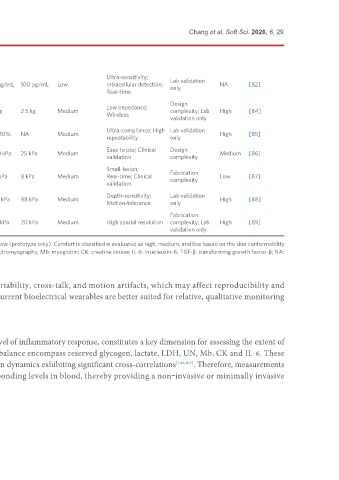
 Note: Technological maturity is evaluated as high (product available), medium (human validation available), and low (prototype only). Comfort is classified is evaluated as high, medium, and low based on the skin conformability
 of the device (influenced by size, weight, substrate stiffness and mechanical structure design). sEMG: Surface electromyography; Mb: myoglobin; CK: creatine kinase; IL-6: Interleukin-6; TGF-β: transforming growth factor-β; NA:
 not available.

 Nevertheless, sEMG and ECG signals are susceptible to electrode placement variability, cross-talk, and motion artifacts, which may affect reproducibility and
 quantitative consistency across individuals and during dynamic activities. Thus, current bioelectrical wearables are better suited for relative, qualitative monitoring
 rather than absolute, quantitative measurement.

 Wearable biochemical sensors
 The balance between energy substrate consumption and synthesis, along with the level of inflammatory response, constitutes a key dimension for assessing the extent of
 muscle fatigue, damage, and repair efficiency [105] . Core biomarkers reflecting this balance encompass reserved glycogen, lactate, LDH, UN, Mb, CK and IL-6. These
 biomarkers are present in blood, sweat, and interstitial fluid, with their concentration dynamics exhibiting significant cross-correlations [106,107] . Therefore, measurements
 obtained from sweat or interstitial fluid can be utilized to estimate their corresponding levels in blood, thereby providing a non‑invasive or minimally invasive
 analytical approach for evaluating muscle metabolic status.

