


Page 107 - Read Online
P. 107
Chang et al. Soft Sci. 2026, 6, 29                                               Page 15 of 26


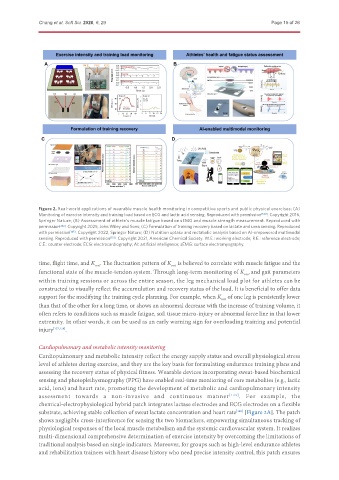
               Figure 2. Real-world applications of wearable muscle health monitoring in competitive sports and public physical exercises; (A)
               Monitoring of exercise intensity and training load based on ECG and lactic acid sensing. Reproduced with permission [140] . Copyright 2016,
               Springer Nature; (B) Assessment of athlete’s muscle fatigue based on sEMG and muscle strength measurement. Reproduced with
               permission [142] . Copyright 2025, John Wiley and Sons; (C) Formulation of training recovery based on lactate and urea sensing. Reproduced
               with permission [145] . Copyright 2022, Springer Nature; (D) Nutrition uptake and metabolic analysis based on AI-empowered multimodal
               sensing. Reproduced with permission [151] . Copyright 2021, American Chemical Society. W.E.: working electrode; R.E.: reference electrode;
               C.E.: counter electrode; ECG: electrocardiography; AI: artificial intelligence; sEMG: surface electromyography.


               time, flight time, and K . The fluctuation pattern of K  is believed to correlate with muscle fatigue and the
                                  vert
                                                             vert
               functional state of the muscle-tendon system. Through long-term monitoring of K  and gait parameters
                                                                                       vert
               within training sessions or across the entire season, the leg mechanical load plot for athletes can be
               constructed to visually reflect the accumulation and recovery status of the load. It is beneficial to offer data
               support for the modifying the training cycle planning. For example, when K  of one leg is persistently lower
                                                                               vert
               than that of the other for a long time, or shows an abnormal decrease with the increase of training volume, it
               often refers to conditions such as muscle fatigue, soft tissue micro-injury or abnormal force line in that lower
               extremity. In other words, it can be used as an early warning sign for overloading training and potential
               injury [137,138] .


               Cardiopulmonary and metabolic intensity monitoring
               Cardiopulmonary and metabolic intensity reflect the energy supply status and overall physiological stress
               level of athletes during exercise, and they are the key basis for formulating endurance training plans and
               assessing the recovery status of physical fitness. Wearable devices incorporating sweat-based biochemical
               sensing and photoplethysmography (PPG) have enabled real-time monitoring of core metabolites (e.g., lactic
               acid, ions) and heart rate, promoting the development of metabolic and cardiopulmonary intensity
               assessment   towards   a   non-invasive   and   continuous   manner [139] .   For   example,   the
               chemical-electrophysiological hybrid patch integrates lactase electrodes and ECG electrodes on a flexible
               substrate, achieving stable collection of sweat lactate concentration and heart rate  [Figure 2A]. The patch
                                                                                    [140]
               shows negligible cross-interference for sensing the two biomarkers, empowering simultaneous tracking of
               physiological responses of the local muscle metabolism and the systemic cardiovascular system. It realizes
               multi-dimensional comprehensive determination of exercise intensity by overcoming the limitations of
               traditional analysis based on single indicators. Moreover, for groups such as high-level endurance athletes
               and rehabilitation trainees with heart disease history who need precise intensity control, this patch ensures

