


Page 133 - Read Online
P. 133
Chen et al. Soft Sci. 2026, 6, 48                                                Page 11 of 19


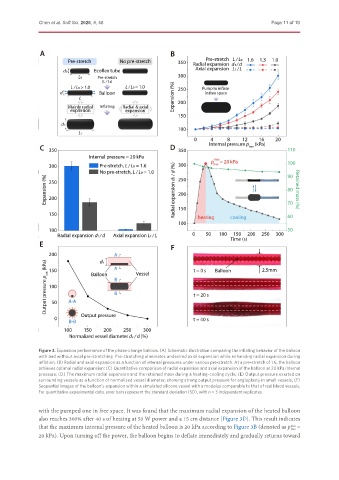
               Figure 3. Expansion performance of the phase-change balloon. (A) Schematic illustration comparing the inflating behavior of the balloon
               with and without axial pre-stretching. Pre-stretching eliminates undesired axial expansion while enhancing radial expansion during
               inflation; (B) Radial and axial expansion as a function of internal pressures under various pre-stretch. At a pre-stretch of 1.6, the balloon
               achieves optimal radial expansion; (C) Quantitative comparison of radial expansion and axial expansion of the balloon at 20 kPa internal
               pressure; (D) The maximum radial expansion and the retained mass during a heating-cooling cycle; (E) Output pressure exerted on
               surrounding vessels as a function of normalized vessel diameter, showing strong output pressure for angioplasty in small vessels; (F)
               Sequential images of the balloon’s expansion within a simulated silicone vessel with a modulus comparable to that of real blood vessels.
               For quantitative experimental data, error bars represent the standard deviation (SD), with n = 3 independent replicates.


               with the pumped one in free space. It was found that the maximum radial expansion of the heated balloon
               also reaches 300% after 40 s of heating at 50 W power and a 15 cm distance [Figure 3D]. This result indicates
                                                                                                       max
               that the maximum internal pressure of the heated balloon is 20 kPa according to Figure 3B (denoted as p  =
                                                                                                       free
               20 kPa). Upon turning off the power, the balloon begins to deflate immediately and gradually returns toward

