


Page 135 - Read Online
P. 135
Chen et al. Soft Sci. 2026, 6, 48                                                Page 13 of 19


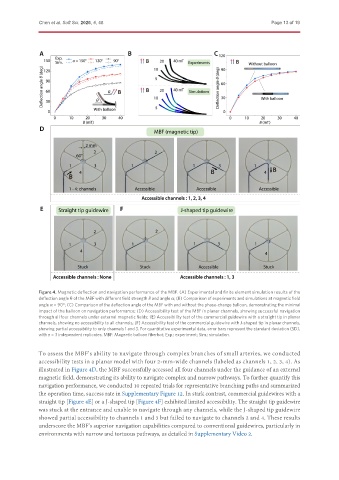
               Figure 4. Magnetic deflection and navigation performance of the MBF. (A) Experimental and finite element simulation results of the
               deflection angle θ of the MBF with different field strength B and angle α; (B) Comparison of experiments and simulations at magnetic field
               angle α = 90°; (C) Comparison of the deflection angle of the MBF with and without the phase-change balloon, demonstrating the minimal
               impact of the balloon on navigation performance; (D) Accessibility test of the MBF in planar channels, showing successful navigation
               through all four channels under external magnetic fields; (E) Accessibility test of the commercial guidewire with a straight tip in planar
               channels, showing no accessibility to all channels; (F) Accessibility test of the commercial guidewire with J-shaped tip in planar channels,
               showing partial accessibility to only channels 1 and 3. For quantitative experimental data, error bars represent the standard deviation (SD),
               with n = 3 independent replicates. MBF: Magnetic balloon fiberbot; Exp.: experiment; Sim.: simulation.

               To assess the MBF’s ability to navigate through complex branches of small arteries, we conducted
               accessibility tests in a planar model with four 2-mm-wide channels (labeled as channels 1, 2, 3, 4). As
               illustrated in Figure 4D, the MBF successfully accessed all four channels under the guidance of an external
               magnetic field, demonstrating its ability to navigate complex and narrow pathways. To further quantify this
               navigation performance, we conducted 10 repeated trials for representative branching paths and summarized
               the operation time, success rate in Supplementary Figure 12. In stark contrast, commercial guidewires with a
               straight tip [Figure 4E] or a J-shaped tip [Figure 4F] exhibited limited accessibility. The straight tip guidewire
               was stuck at the entrance and unable to navigate through any channels, while the J-shaped tip guidewire
               showed partial accessibility to channels 1 and 3 but failed to navigate to channels 2 and 4. These results
               underscore the MBF’s superior navigation capabilities compared to conventional guidewires, particularly in
               environments with narrow and tortuous pathways, as detailed in Supplementary Video 2.

