


Page 8 - Read Online
P. 8
Wu et al. Soft Sci 2024;4:42  https://dx.doi.org/10.20517/ss.2024.51             Page 5 of 13

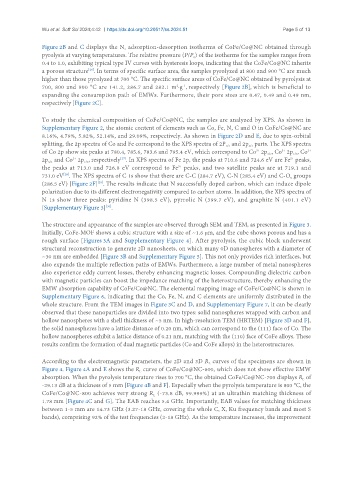
               Figure 2B and C displays the N  adsorption-desorption isotherms of CoFe/Co@NC obtained through
                                           2
               pyrolysis at varying temperatures. The relative pressure (P/P ) of the isotherms for the samples ranges from
                                                                  0
               0.4 to 1.0, exhibiting typical type IV curves with hysteresis loops, indicating that the CoFe/Co@NC inherits
               a porous structure . In terms of specific surface area, the samples pyrolyzed at 800 and 900 °C are much
                               [26]
               higher than those pyrolyzed at 700 °C. The specific surface areas of CoFe/Co@NC obtained by pyrolysis at
                                                               -1
                                                             2
               700, 800 and 900 °C are 141.2, 286.7 and 282.1 m ·g , respectively [Figure 2B], which is beneficial to
               expanding the consumption path of EMWs. Furthermore, their pore sizes are 0.47, 0.49 and 0.49 nm,
               respectively [Figure 2C].
               To study the chemical composition of CoFe/Co@NC, the samples are analyzed by XPS. As shown in
               Supplementary Figure 2, the atomic content of elements such as Co, Fe, N, C and O in CoFe/Co@NC are
               8.16%, 4.79%, 5.82%, 52.14%, and 29.09%, respectively. As shown in Figure 2D and E, due to spin-orbital
               splitting, the 2p spectra of Co and Fe correspond to the XPS spectra of 2P  and 2p  parts. The XPS spectra
                                                                             1/2
                                                                                     3/2
                                                                                                3+
                                                                                                         2+
                                                                                       3+
               of Co 2p show six peaks at 780.4, 785.6, 783.6 and 795.4 eV, which correspond to Co  2p , Co  2p , Co
                                                                                                    1/2
                                                                                           3/2
               2p  and Co  2p , respectively . In XPS spectra of Fe 2p, the peaks at 710.6 and 724.6 eV are Fe  peaks,
                          2+
                                          [27]
                                                                                                   2+
                 3/2
                             1/2
               the peaks at 713.0 and 726.8 eV correspond to Fe  peaks, and two satellite peaks are at 719.1 and
                                                             3+
               731.0 eV . The XPS spectra of C 1s show that there are C-C (284.7 eV), C-N (285.4 eV) and C-O  groups
                      [28]
                                                                                                   x
                                  [29]
               (286.5 eV) [Figure 2F] . The results indicate that N successfully doped carbon, which can induce dipole
               polarization due to its different electronegativity compared to carbon atoms. In addition, the XPS spectra of
               N 1s show three peaks: pyridine N (398.5 eV), pyrrolic N (399.7 eV), and graphite N (401.1 eV)
               [Supplementary Figure 3] .
                                     [30]
               The structure and appearance of the samples are observed through SEM and TEM, as presented in Figure 3.
               Initially, CoFe-MOF shows a cubic structure with a size of ~1.6 μm, and the cube shows porous and has a
               rough surface [Figures 3A and Supplementary Figure 4]. After pyrolysis, the cubic block underwent
               structural reconstruction to generate 2D nanosheets, on which many 0D nanospheres with a diameter of
               ~30 nm are embedded [Figure 3B and Supplementary Figure 5]. This not only provides rich interfaces, but
               also expands the multiple reflection paths of EMWs. Furthermore, a large number of metal nanospheres
               also experience eddy current losses, thereby enhancing magnetic losses. Compounding dielectric carbon
               with magnetic particles can boost the impedance matching of the heterostructure, thereby enhancing the
               EMW absorption capability of CoFe/Co@NC. The elemental mapping image of CoFe/Co@NC is shown in
               Supplementary Figure 6, indicating that the Co, Fe, N, and C elements are uniformly distributed in the
               whole structure. From the TEM images in Figure 3C and D, and Supplementary Figure 7, it can be clearly
               observed that these nanoparticles are divided into two types: solid nanospheres wrapped with carbon and
               hollow nanospheres with a shell thickness of ~5 nm. In high-resolution TEM (HRTEM) [Figure 3D and F],
               the solid nanospheres have a lattice distance of 0.20 nm, which can correspond to the (111) face of Co. The
               hollow nanospheres exhibit a lattice distance of 0.21 nm, matching with the (110) face of CoFe alloys. These
               results confirm the formation of dual magnetic particles (Co and CoFe alloys) in the heterostructures.

               According to the electromagnetic parameters, the 2D and 3D R  curves of the specimens are shown in
                                                                       L
               Figure 4. Figure 4A and E shows the R  curve of CoFe/Co@NC-600, which does not show effective EMW
                                                L
               absorption. When the pyrolysis temperature rises to 700 °C, the obtained CoFe/Co@NC-700 displays R  of
                                                                                                       L
               -29.13 dB at a thickness of 5 mm [Figure 4B and F]. Especially when the pyrolysis temperature is 800 °C, the
               CoFe/Co@NC-800 achieves very strong R  (-73.8 dB, 99.999%) at an ultrathin matching thickness of
                                                     L
               1.78 mm [Figure 4C and G]. The EAB reaches 5.4 GHz. Importantly, EAB values for matching thickness
               between 1-5 mm are 14.73 GHz (3.27-18 GHz, covering the whole C, X, Ku frequency bands and most S
               bands), comprising 92% of the test frequencies (2-18 GHz). As the temperature increases, the improvement

