


Page 13 - Read Online
P. 13
Page 10 of 13                             Wu et al. Soft Sci 2024;4:42  https://dx.doi.org/10.20517/ss.2024.51


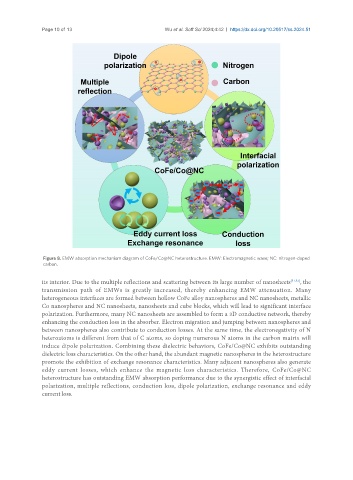
                Figure 8. EMW absorption mechanism diagram of CoFe/Co@NC heterostructure. EMW: Electromagnetic wave; NC: nitrogen-doped
                carbon.

               its interior. Due to the multiple reflections and scattering between its large number of nanosheets [51,52] , the
               transmission  path  of  EMWs  is  greatly  increased,  thereby  enhancing  EMW  attenuation.  Many
               heterogeneous interfaces are formed between hollow CoFe alloy nanospheres and NC nanosheets, metallic
               Co nanospheres and NC nanosheets, nanosheets and cube blocks, which will lead to significant interface
               polarization. Furthermore, many NC nanosheets are assembled to form a 3D conductive network, thereby
               enhancing the conduction loss in the absorber. Electron migration and jumping between nanospheres and
               between nanospheres also contribute to conduction losses. At the same time, the electronegativity of N
               heteroatoms is different from that of C atoms, so doping numerous N atoms in the carbon matrix will
               induce dipole polarization. Combining these dielectric behaviors, CoFe/Co@NC exhibits outstanding
               dielectric loss characteristics. On the other hand, the abundant magnetic nanospheres in the heterostructure
               promote the exhibition of exchange resonance characteristics. Many adjacent nanospheres also generate
               eddy current losses, which enhance the magnetic loss characteristics. Therefore, CoFe/Co@NC
               heterostructure has outstanding EMW absorption performance due to the synergistic effect of interfacial
               polarization, multiple reflections, conduction loss, dipole polarization, exchange resonance and eddy
               current loss.

