


Page 131 - Read Online
P. 131
Xu et al. Soft Sci. 2025, 5, 43  https://dx.doi.org/10.20517/ss.2025.63          Page 5 of 16

               Ti CT  and Ti CT /Si N  composites for microwave absorption testing were tailored and refined into
                            2
                    X
                 2
                                    4
                                  3
                               X
               samples of 22.86 mm × 10.16 mm × x mm in dimension, and their dielectric constant was measured by the
               waveguide method on a vector network analyzer (VNA, MS4644A, Anritsu, Japan) through the waveguide
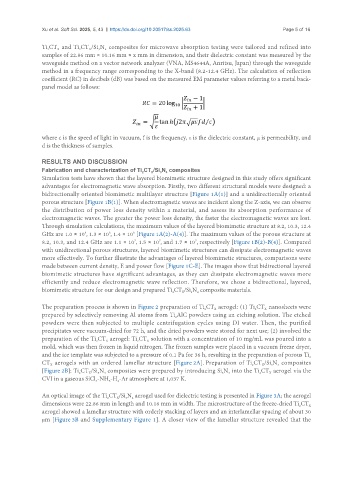
               method in a frequency range corresponding to the X-band (8.2-12.4 GHz). The calculation of reflection
               coefficient (RC) in decibels (dB) was based on the measured EM parameter values referring to a metal back-
               panel model as follows:


               where c is the speed of light in vacuum, f is the frequency, ε is the dielectric constant, μ is permeability, and
               d is the thickness of samples.


               RESULTS AND DISCUSSION
               Fabrication and characterization of Ti CT /Si N  composites
                                                 2  X  3  4
               Simulation tests have shown that the layered biomimetic structure designed in this study offers significant
               advantages for electromagnetic wave absorption. Firstly, two different structural models were designed: a
               bidirectionally oriented biomimetic multilayer structure [Figure 1A(1)] and a unidirectionally oriented
               porous structure [Figure 1B(1)]. When electromagnetic waves are incident along the Z-axis, we can observe
               the distribution of power loss density within a material, and assess its absorption performance of
               electromagnetic waves. The greater the power loss density, the faster the electromagnetic waves are lost.
               Through simulation calculations, the maximum values of the layered biomimetic structure at 8.2, 10.3, 12.4
               GHz are 1.0 × 10 , 1.3 × 10 , 1.4 × 10  [Figure 1A(2)-A(4)]. The maximum values of the porous structure at
                              8
                                              8
                                      8
                                              7
               8.2, 10.3, and 12.4 GHz are 1.1 × 10 , 1.5 × 10 , and 1.7 × 10 , respectively [Figure 1B(2)-B(4)]. Compared
                                                                   7
                                                       7
               with unidirectional porous structures, layered biomimetic structures can dissipate electromagnetic waves
               more effectively. To further illustrate the advantages of layered biomimetic structures, comparisons were
               made between current density, E and power flow [Figure 1C-E]. The images show that bidirectional layered
               biomimetic structures have significant advantages, as they can dissipate electromagnetic waves more
               efficiently and reduce electromagnetic wave reflection. Therefore, we chose a bidirectional, layered,
               biomimetic structure for our design and prepared Ti CT /Si N  composite materials.
                                                                 3
                                                              X
                                                           2
                                                                   4
               The preparation process is shown in Figure 2 preparation of Ti CT  aerogel: (1) Ti CT  nanosheets were
                                                                         X
                                                                      2
                                                                                       2
                                                                                          X
               prepared by selectively removing Al atoms from Ti AlC powders using an etching solution. The etched
                                                            2
               powders were then subjected to multiple centrifugation cycles using DI water. Then, the purified
               precipitates were vacuum-dried for 72 h, and the dried powders were stored for next use; (2) involved the
               preparation of the Ti CT  aerogel: Ti CT  solution with a concentration of 10 mg/mL was poured into a
                                     X
                                 2
                                                   X
                                               2
               mold, which was then frozen in liquid nitrogen. The frozen samples were placed in a vacuum freeze dryer,
               and the ice template was subjected to a pressure of 0.1 Pa for 36 h, resulting in the preparation of porous Ti 2
               CT  aerogels with an ordered lamellar structure [Figure 2A]. Preparation of Ti CT /Si N  composites
                                                                                         X
                  X
                                                                                      2
                                                                                               4
                                                                                            3
               [Figure 2B]: Ti CT /Si N  composites were prepared by introducing Si N  into the Ti CT  aerogel via the
                                                                                        2
                                                                              4
                                                                            3
                                                                                            X
                                  3
                                    4
                               X
                            2
               CVI in a gaseous SiCl -NH -H -Ar atmosphere at 1,037 K.
                                 4
                                         2
                                      3
               An optical image of the Ti CT /Si N  aerogel used for dielectric testing is presented in Figure 3A; the aerogel
                                             4
                                           3
                                     2
                                        X
               dimensions were 22.86 mm in length and 10.16 mm in width. The microstructure of the freeze-dried Ti CT
                                                                                                      2
                                                                                                         X
               aerogel showed a lamellar structure with orderly stacking of layers and an interlamellar spacing of about 30
               μm [Figure 3B and Supplementary Figure 1]. A closer view of the lamellar structure revealed that the

