


Page 115 - Read Online
P. 115
Page 14 of 25                           Hao et al. Soft Sci. 2025, 5, 39  https://dx.doi.org/10.20517/ss.2025.48


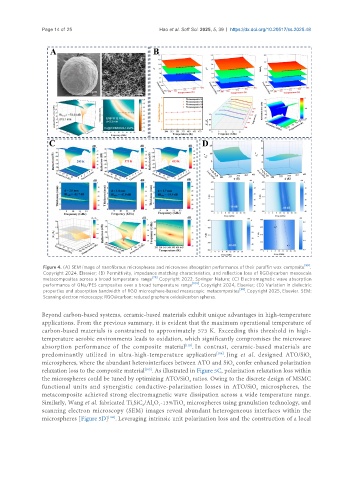
                Figure 4. (A) SEM image of nanofibrous microspheres and microwave absorption performance of their paraffin wax  composite [99] .
                Copyright 2024, Elsevier; (B) Permittivity, impedance matching characteristics, and reflection loss of RGO@carbon mesoscale
                metacomposites across a broad temperature  range [79] . Copyright 2022, Springer Nature; (C) Electromagnetic wave absorption
                                                                  [100]
                performance of GNs/PES composites over a broad temperature  range  . Copyright 2024, Elsevier; (D) Variation in dielectric
                                                                                  [96]
                properties and absorption bandwidth of RGO microsphere-based mesoscopic  metacomposites  . Copyright 2025, Elsevier. SEM:
                Scanning electron microscopy; RGO@carbon: reduced graphene oxide@carbon spheres.
               Beyond carbon-based systems, ceramic-based materials exhibit unique advantages in high-temperature
               applications. From the previous summary, it is evident that the maximum operational temperature of
               carbon-based materials is constrained to approximately 573 K. Exceeding this threshold in high-
               temperature aerobic environments leads to oxidation, which significantly compromises the microwave
               absorption  performance  of  the  composite  material . In  contrast,  ceramic-based  materials  are
                                                               [103]
               predominantly  utilized  in  ultra-high-temperature  applications . Jing  et  al.  designed  ATO/SiO
                                                                          [104]
                                                                                                         2
               microspheres, where the abundant heterointerfaces between ATO and SiO  confer enhanced polarization
                                                                               2
               relaxation loss to the composite material . As illustrated in Figure 5C, polarization relaxation loss within
                                                  [105]
               the microspheres could be tuned by optimizing ATO/SiO  ratios. Owing to the discrete design of MSMC
                                                                 2
               functional  units  and  synergistic  conductive-polarization  losses  in  ATO/SiO   microspheres,  the
                                                                                       2
               metacomposite achieved strong electromagnetic wave dissipation across a wide temperature range.
               Similarly, Wang et al. fabricated Ti SiC /Al O -13%TiO  microspheres using granulation technology, and
                                              3
                                                    2
                                                       3
                                                 2
                                                               2
               scanning electron microscopy (SEM) images reveal abundant heterogeneous interfaces within the
               microspheres [Figure 5D] . Leveraging intrinsic unit polarization loss and the construction of a local
                                     [106]

