


Page 116 - Read Online
P. 116
Page 4 of 9                             Yin et al. Soft Sci. 2025, 5, 30  https://dx.doi.org/10.20517/ss.2025.15

               Table 1. Performance comparison and their application in wearable sensors of representative gelatin-based tough biogels
                                       Mechanical property                 Admirable
                Composition                             Conductivity Function           Application    Ref.
                                      Strength stretchability              performance
                Gelatin/citric acid/sugar/glycerol 10-140   180%-325%  /  Substrate  Self-healing;   Integrated multimodal  [28]
                                      kPa                                  Adhesion;    e-skin
                                                                           Recycling;
                Gelatin/glycerol      /      Flexible   /          Substrate  Recycling;  Capacitive touch   [29]
                                                                                        sensors
                Gelatin/alginate/glycerol  ~ 2.0 MPa 540%  /       Substrate  Self-healing;   Integrated   [38]
                                                                           Recycling;   multifunctional soft
                                                                                        electronics
                                                                 −1
                Gelatin/alginate/glycerol/metal   0.64-1.88  45-150%  0.17-6.1 mS m  Active   /  Thermal, humidity,   [34]
                cations               MPa                          sensing              strain sensors;
                                                                   material             Photodetector
                Gelatin/betaine-[Fe(CN) ] 3-/4-  0.44 MPa 247%  4.04 S m -1  Active   Self-healing  Thermal sensor array  [35]
                               6
                                                                   sensing
                                                                   material
                Gelatin/citric acid/NaCl  ~ 0.8 MPa ~ 460%  ~ 155 ohms at   Active   Temperature-  On-skin bioelectrode   [36]
                                                        100 Hz     sensing   controlled phase   for EEG recording
                                                                   material  transition;
                                                                           Adhesion
                Gelatin/sodium pyrrolidone   ~ 0.18 MPa 256%  25 mS cm -1  Active   Adhesion;   Bio-interface for   [38]
                carboxylic acid                                    sensing   Temperature-  recording
                                                                   material  controlled phase   electrophysiology
                                                                           transition;   signals
                                                                           Self-healing
                                                               -1
                Gelatin/MXene/tannic   1.81 MPa  330%   ~ 80 mS cm  Active  Adhesion    Thermal, strain   [43]
                acid/glycerol                                      sensing              sensors
                                                                   material
                Gelatin/PEDOT:PSS/glycerol-  ~ 1-3 MPa  200-375%  0.29-0.91 S/m Active   Adhesion  Bioelectrode for ECG   [45]
                choline chloride                                   sensing              and EMG signal
                                                                   material             detection

               “/” indicates “not available” in the references. The symbol “~” represents the estimated value in their articles. EEG: Electroencephalogram; ECG:
               electrocardiogram; EMG: electromyography; PEDOT: Poly(3,4-ethylenedioxythiophene); PSS: poly(styrenesulfonate).


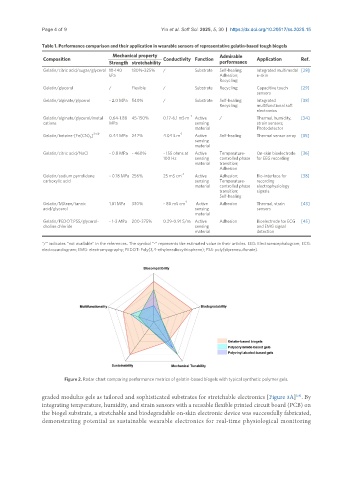
                       Figure 2. Radar chart comparing performance metrics of gelatin-based biogels with typical synthetic polymer gels.


               graded modulus gels as tailored and sophisticated substrates for stretchable electronics [Figure 3A] . By
                                                                                                     [28]
               integrating temperature, humidity, and strain sensors with a reusable flexible printed circuit board (PCB) on
               the biogel substrate, a stretchable and biodegradable on-skin electronic device was successfully fabricated,
               demonstrating potential as sustainable wearable electronics for real-time physiological monitoring

