


Page 11 - Read Online
P. 11
He et al. Soft Sci 2024;4:37  https://dx.doi.org/10.20517/ss.2024.32             Page 9 of 27


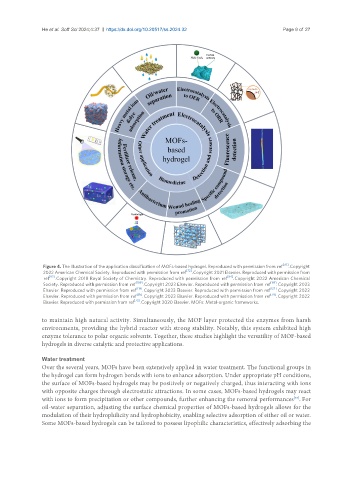
                Figure 4. The illustration of the application classification of MOFs-based hydrogel. Reproduced with permission from ref [70] . Copyright
                2022 American Chemical Society. Reproduced with permission from ref [72] . Copyright 2021 Elsevier. Reproduced with permission from
                ref [92] . Copyright 2018 Royal Society of Chemistry. Reproduced with permission from  ref [94] . Copyright 2022 American Chemical
                Society. Reproduced with permission from  ref [109] . Copyright 2023 Elsevier. Reproduced with permission from  ref [98] . Copyright 2023
                Elsevier. Reproduced with permission from ref [119] . Copyright 2023 Elsevier. Reproduced with permission from ref [127] . Copyright 2022
                                               [85]                                         [76]
                Elsevier. Reproduced with permission from  ref  . Copyright 2023 Elsevier. Reproduced with permission from  ref  . Copyright 2022
                                              [73]
                Elsevier. Reproduced with permission from ref  . Copyright 2020 Elsevier. MOFs: Metal-organic frameworks.
               to maintain high natural activity. Simultaneously, the MOF layer protected the enzymes from harsh
               environments, providing the hybrid reactor with strong stability. Notably, this system exhibited high
               enzyme tolerance to polar organic solvents. Together, these studies highlight the versatility of MOF-based
               hydrogels in diverse catalytic and protective applications.

               Water treatment
               Over the several years, MOFs have been extensively applied in water treatment. The functional groups in
               the hydrogel can form hydrogen bonds with ions to enhance adsorption. Under appropriate pH conditions,
               the surface of MOFs-based hydrogels may be positively or negatively charged, thus interacting with ions
               with opposite charges through electrostatic attractions. In some cases, MOFs-based hydrogels may react
               with ions to form precipitation or other compounds, further enhancing the removal performances . For
                                                                                                    [73]
               oil-water separation, adjusting the surface chemical properties of MOFs-based hydrogels allows for the
               modulation of their hydrophilicity and hydrophobicity, enabling selective adsorption of either oil or water.
               Some MOFs-based hydrogels can be tailored to possess lipophilic characteristics, effectively adsorbing the

