


Page 12 - Read Online
P. 12
Page 10 of 27                             He et al. Soft Sci 2024;4:37  https://dx.doi.org/10.20517/ss.2024.32


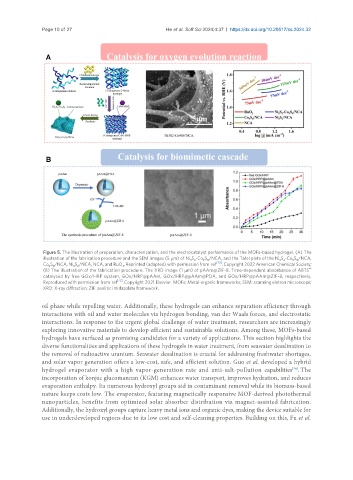
                Figure 5. The illustration of preparation, characterization, and the electrocatalyst performance of the MOFs-based hydrogel. (A) The
                illustration of the fabrication procedure and the SEM images (5 μm) of Ni S -Co S /NCA, and the Tafel plots of the Ni S -Co S /NCA,
                                                                 3 2  9 8                      3 2  9 8
                                                                          [70]
                Co S /NCA, Ni S /NCA, NCA, and RuO . Reprinted (adapted) with permission from ref  . Copyright 2022 American Chemical Society;
                 9 8      3 2             2
                                                                                                         •+
                (B) The illustration of the fabrication procedure. The XRD image (1 μm) of pAAm@ZIF-8. Time-dependent absorbance of ABTS
                catalyzed by free GOx/HRP system, GOx/HRP@pAAm, GOx/HRP@pAAm@PDA, and GOx/HRP@pAAm@ZIF-8, respectively.
                Reproduced with permission from ref [72] . Copyright 2021 Elsevier. MOFs: Metal-organic frameworks; SEM: scanning eletron microscope;
                XRD: X-ray diffraction; ZIF: zeolitic imidazolate framework.
               oil phase while repelling water. Additionally, these hydrogels can enhance separation efficiency through
               interactions with oil and water molecules via hydrogen bonding, van der Waals forces, and electrostatic
               interactions. In response to the urgent global challenge of water treatment, researchers are increasingly
               exploring innovative materials to develop efficient and sustainable solutions. Among these, MOFs-based
               hydrogels have surfaced as promising candidates for a variety of applications. This section highlights the
               diverse functionalities and applications of these hydrogels in water treatment, from seawater desalination to
               the removal of radioactive uranium. Seawater desalination is crucial for addressing freshwater shortages,
               and solar vapor generation offers a low-cost, safe, and efficient solution. Guo et al. developed a hybrid
               hydrogel evaporator with a high vapor-generation rate and anti-salt-pollution capabilities . The
                                                                                                    [74]
               incorporation of konjac glucomannan (KGM) enhances water transport, improves hydration, and reduces
               evaporation enthalpy. Its numerous hydroxyl groups aid in contaminant removal while its biomass-based
               nature keeps costs low. The evaporator, featuring magnetically responsive MOF-derived photothermal
               nanoparticles, benefits from optimized solar absorber distribution via magnet-assisted fabrication.
               Additionally, the hydroxyl groups capture heavy metal ions and organic dyes, making the device suitable for
               use in underdeveloped regions due to its low cost and self-cleaning properties. Building on this, Fu et al.

