


Page 16 - Read Online
P. 16
Page 14 of 27                             He et al. Soft Sci 2024;4:37  https://dx.doi.org/10.20517/ss.2024.32


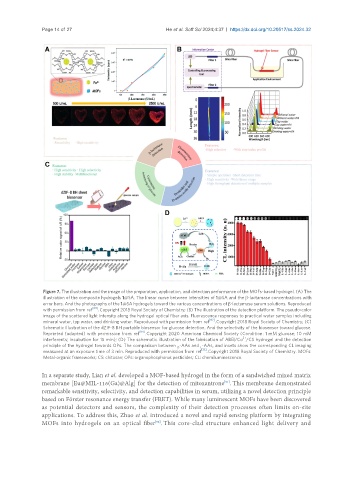
                Figure 7. The illustration and the image of the preparation, application, and detection performance of the MOFs-based hydrogel. (A) The
                illustration of the composite hydrogels 1@SA. The linear curve between intensities of 1@SA and the β-lactamase concentrations with
                error bars. And the photographs of the 1@SA hydrogels toward the various concentrations of β-lactamase serum solutions. Reproduced
                with permission from ref [89] . Copyright 2018 Royal Society of Chemistry; (B) The illustration of the detection platform. The pseudo-color
                image of the scattered light intensity along the hydrogel optical fiber axis. Fluorescence responses to practical water samples including
                mineral water, tap water, and drinking water. Reproduced with permission from ref [92] . Copyright 2018 Royal Society of Chemistry; (C)
                Schematic illustration of the dZIF-8 BH portable biosensor for glucose detection. And the selectivity of the biosensor toward glucose.
                Reprinted (adapted) with permission from  ref [94] . Copyright 2020 American Chemical Society (Condition: 1 mM glucose; 10 mM
                                                                                   2+
                interferents; incubation for 15 min); (D) The schematic illustration of the fabrication of ABEI/Co /CS hydrogel and the detection
                principle of the hydrogel towards OPs. The comparison between  -AAs and  -AAs, and insets show the corresponding CL imaging
                                                             D
                                                                     L
                measured at an exposure time of 3 min. Reproduced with permission from  ref [13] . Copyright 2018 Royal Society of Chemistry. MOFs:
                Metal-organic frameworks; CS: chitosan; OPs: organophosphorus pesticides; CL: chemiluminescence.
               In a separate study, Lian et al. developed a MOF-based hydrogel in the form of a sandwiched mixed matrix
                                                                             [91]
               membrane [Eu@MIL-116(Ga)@Alg] for the detection of mitoxantrone . This membrane demonstrated
               remarkable sensitivity, selectivity, and detection capabilities in serum, utilizing a novel detection principle
               based on Förster resonance energy transfer (FRET). While many luminescent MOFs have been discovered
               as potential detectors and sensors, the complexity of their detection processes often limits on-site
               applications. To address this, Zhao et al. introduced a novel and rapid sensing platform by integrating
               MOFs into hydrogels on an optical fiber . This core-clad structure enhanced light delivery and
                                                     [92]

