


Page 17 - Read Online
P. 17
Huang et al. Soft Sci 2024;4:40  https://dx.doi.org/10.20517/ss.2024.37         Page 15 of 35


                                                                                   -1
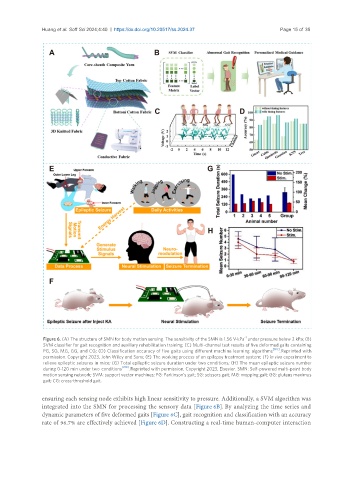
                Figure 6. (A) The structure of SMN for body motion sensing. The sensitivity of the SMN is 1.56 V·kPa  under pressure below 2 kPa; (B)
                SVM classifier for gait recognition and auxiliary rehabilitation training; (C) Multi-channel test results of five deformed gaits containing
                                                                                             [187]
                PG, SG, MG, GG, and CG; (D) Classification accuracy of five gaits using different machine learning  algorithms  . Reprinted with
                permission. Copyright 2023, John Wiley and Sons; (E) The working process of an epilepsy treatment system; (F) In vivo experiment to
                relieve epileptic seizures in mice; (G) Total epileptic seizure duration under two conditions; (H) The mean epileptic seizure number
                                          [210]
                during 0-120 min under two conditions  . Reprinted with permission. Copyright 2023, Elsevier. SMN: Self-powered multi-point body
                motion sensing network; SVM: support vector machines; PG: Parkinson’s gait; SG: scissors gait; MG: mopping gait; GG: gluteus maximus
                gait; CG: cross-threshold gait.
               ensuring each sensing node exhibits high linear sensitivity to pressure. Additionally, a SVM algorithm was
               integrated into the SMN for processing the sensory data [Figure 6B]. By analyzing the time series and
               dynamic parameters of five deformed gaits [Figure 6C], gait recognition and classification with an accuracy
               rate of 96.7% are effectively achieved [Figure 6D]. Constructing a real-time human-computer interaction

