


Page 19 - Read Online
P. 19
Huang et al. Soft Sci 2024;4:40  https://dx.doi.org/10.20517/ss.2024.37         Page 17 of 35

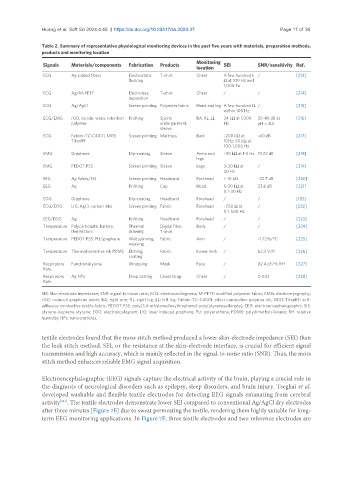
               Table 2. Summary of representative physiological monitoring devices in the past five years with materials, preparation methods,
               products and monitoring location
                                                                   Monitoring
                Signals  Materials/components  Fabrication  Products        SEI         SNR/sensitivity Ref.
                                                                   location
                ECG      Ag-plated fibers   Electrostatic   T-shirt  Chest  A few hundred k /        [213]
                                            flocking                        Ω at 100 Hz and
                                                                            1,000 Pa
                ECG      Ag/M-PETF          Electroless   T-shirt  Chest    /           /            [214]
                                            deposition
                ECG      Ag/AgCl            Screen printing Polyester fabric  Hand and leg A few hundred Ω  /  [215]
                                                                            within 100 Hz
                ECG/EMG  rGO, sericin, water retention  Knitting  Sports   RA, RL, LL  24 kΩ at 1,000   35-40 dB at   [216]
                         polymer                       undergarment,        Hz          pH = 4.3
                                                       sleeve
                ECG      Fabink-TC-C4001, MOS   Screen printing Mattress  Back  ~200 kΩ at   -40 dB  [217]
                         TitanRF                                            10Hz; 50 kΩ at
                                                                            100-1,000 Hz
                EMG      Graphene           Dip-coating  Sleeve    Arms and   ~90 kΩ at 1-5 Hz 19.23 dB  [218]
                                                                   legs
                EMG      PEDOT:PSS          Screen printing Sleeve  Legs    3-20 kΩ at   /           [219]
                                                                            30 Hz
                EEG      Ag flakes/SIS      Screen printing Headband  Forehead  < 10 kΩ  -32.7 dB    [220]
                EEG      Ag                 Knitting   Cap         Head     5-30 kΩ at   33.6 dB     [221]
                                                                            0.1-30 Hz
                EOG      Graphene           Dip-coating  Headband  Forehead  /          /            [183]
                ECG/EOG  LIG, AgCl, carbon inks  Screen printing Fabric  Forehead  ~700 Ω at   /     [222]
                                                                            0.1-500 Hz
                EEG/EOG  Ag                 Knitting   Headband    Forehead  /          /            [223]
                Temperature Polycarbonate, battery,   Thermal   Digital fiber,   Body  /  /          [224]
                         thermistors        drawing    T-shirt
                Temperature PEDOT:PSS, PU/graphene  Wet spinning,   Fabric  Arm  /      -1.72%/°C    [225]
                                            weaving
                Temperature Thermal-sensitive ink PDMS  Etching,   Fabric  Lower limb  /  62.3 V/K   [226]
                                            coating
                Respiratory   Functional yarns  Wrapping  Mask     Face     /           82.4 pF/% RH  [227]
                Rate
                Respiratory   Ag NPs        Drop casting  Chest strap  Chest  /         0.043        [228]
                Rate
               SEI: Skin-electrode impedance; SNR: signal-to-noise ratio; ECG: electrocardiograms; M-PETF: modified polyester fabric; EMG: electromyography;
               rGO: reduced graphene oxide; RA: right arm; RL: right leg; LL: left leg; Fabink-TC-C4001: silver conductive polymer ink; MOS TitanRF: self-
               adhesive conductive textile fabric; PEDOT:PSS: poly(3,4-ethylenedioxythiophene)-poly(styrenesulfonate); EEG: electroencephalographic; SIS:
               styrene-isoprene-styrene; EOG: electrooculogram; LIG: laser induced graphene; PU: polyurethane; PDMS: polydimethylsiloxane; RH: relative
               humidity; NPs: nano-particles.


               textile electrodes found that the moss stitch method produced a lower skin-electrode impedance (SEI) than
               the lock stitch method. SEI, or the resistance at the skin-electrode interface, is crucial for efficient signal
               transmission and high accuracy, which is mainly reflected in the signal-to-noise ratio (SNR). Thus, the moss
               stitch method enhances reliable EMG signal acquisition.


               Electroencephalographic (EEG) signals capture the electrical activity of the brain, playing a crucial role in
               the diagnosis of neurological disorders such as epilepsy, sleep disorders, and brain injury. Tseghai et al.
               developed washable and flexible textile electrodes for detecting EEG signals emanating from cerebral
               activity . The textile electrodes demonstrate lower SEI compared to conventional Ag/AgCl dry electrodes
                     [231]
               after three minutes [Figure 7E] due to sweat permeating the textile, rendering them highly suitable for long-
               term EEG monitoring applications. In Figure 7F, three textile electrodes and two reference electrodes are

