


Page 15 - Read Online
P. 15
Huang et al. Soft Sci 2024;4:40  https://dx.doi.org/10.20517/ss.2024.37         Page 13 of 35

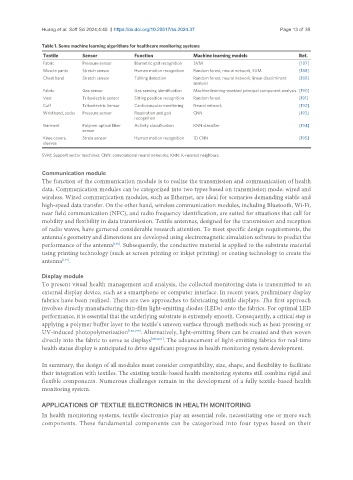
               Table 1. Some machine learning algorithms for healthcare monitoring systems
                Textile      Sensor           Function            Machine learning models             Ref.
                Fabric       Pressure sensor  Biometric gait recognition  SVM                         [187]
                Muscle pants  Stretch sensor  Human motion recognition  Random forest, neural network, SVM  [188]
                Chest band   Stretch sensor   Talking detection   Random forest, neural network, linear discriminant  [189]
                                                                  analysis
                Fabric       Gas sensor       Gas sensing identification  Machine learning-enabled principal component analysis [190]
                Vest         Triboelectric sensor  Sitting position recognition  Random forest        [191]
                Cuff         Triboelectric Sensor  Cardiovascular monitoring  Neural network          [192]
                Wristband, socks  Pressure sensor  Respiration and gait   CNN                         [193]
                                              recognition
                Garment      Polymer optical fiber   Activity classification  KNN classifier          [194]
                             sensor
                Knee covers,   Strain sensor  Human motion recognition  1D CNN                        [195]
                sleeves
               SVM: Support vector machines; CNN: convolutional neural networks; KNN: K-nearest neighbors.


               Communication module
               The function of the communication module is to realize the transmission and communication of health
               data. Communication modules can be categorized into two types based on transmission mode: wired and
               wireless. Wired communication modules, such as Ethernet, are ideal for scenarios demanding stable and
               high-speed data transfer. On the other hand, wireless communication modules, including Bluetooth, Wi-Fi,
               near field communication (NFC), and radio frequency identification, are suited for situations that call for
               mobility and flexibility in data transmission. Textile antennas, designed for the transmission and reception
               of radio waves, have garnered considerable research attention. To meet specific design requirements, the
               antenna’s geometry and dimensions are developed using electromagnetic simulation software to predict the
               performance of the antenna . Subsequently, the conductive material is applied to the substrate material
                                       [196]
               using printing technology (such as screen printing or inkjet printing) or coating technology to create the
                      [197]
               antenna .

               Display module
               To present visual health management and analysis, the collected monitoring data is transmitted to an
               external display device, such as a smartphone or computer interface. In recent years, preliminary display
               fabrics have been realized. There are two approaches to fabricating textile displays. The first approach
               involves directly manufacturing thin-film light-emitting diodes (LEDs) onto the fabrics. For optimal LED
               performance, it is essential that the underlying substrate is extremely smooth. Consequently, a critical step is
               applying a polymer buffer layer to the textile’s uneven surface through methods such as heat pressing or
               UV-induced photopolymerization [198,199] . Alternatively, light-emitting fibers can be created and then woven
               directly into the fabric to serve as displays [200,201] . The advancement of light-emitting fabrics for real-time
               health status display is anticipated to drive significant progress in health monitoring system development.


               In summary, the design of all modules must consider compatibility, size, shape, and flexibility to facilitate
               their integration with textiles. The existing textile-based health monitoring systems still combine rigid and
               flexible components. Numerous challenges remain in the development of a fully textile-based health
               monitoring system.


               APPLICATIONS OF TEXTILE ELECTRONICS IN HEALTH MONITORING
               In health monitoring systems, textile electronics play an essential role, necessitating one or more such
               components. These fundamental components can be categorized into four types based on their

